
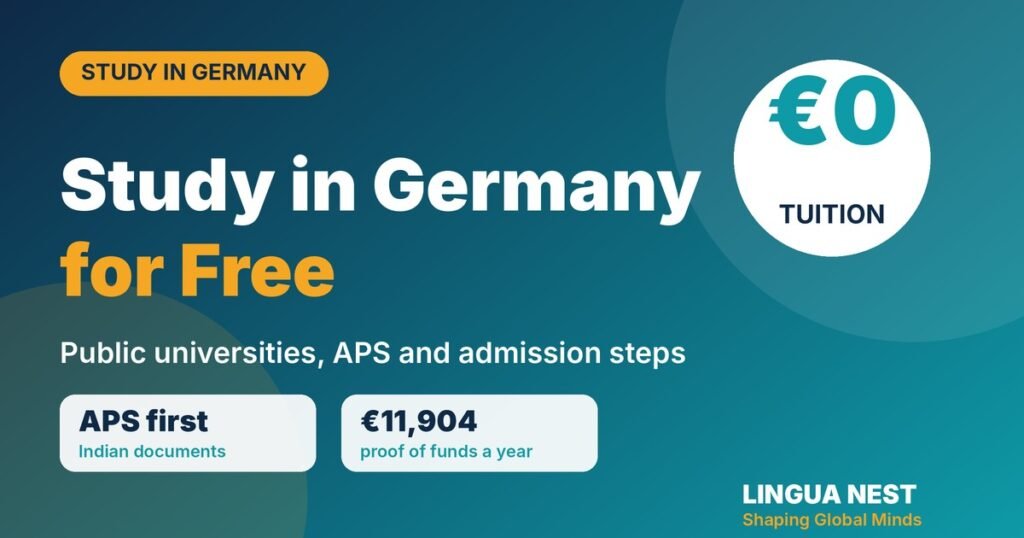
How to Study in Germany for Free: Public Universities, APS Certificate and Admission Steps for Indian Students
Most public universities in Germany charge no tuition fees. Here is what that really means for Indian students, what the APS certificate does and the steps to apply.
“Free education in Germany” is one of the most searched ideas among Indian students, and it is partly true. Most public universities do not charge tuition fees, because higher education is state-funded. But “free” does not mean zero cost: you still pay a semester contribution, you must show money for living costs, and you need the right documents and language level.
This guide explains how to study in Germany for free as an Indian student: what is free and what is not, how the APS certificate fits in, which admission route applies after Class 12 or a bachelor’s degree, and the application steps. It is built on DAAD, APS India and state-government pages, and we flag the points that come only from secondary sources. For the language side, see our guides on the TestDaF vs Goethe exam and how long German A1 to B2 takes.
What “Free” Really Means at German Public Universities
According to DAAD New Delhi’s bachelor’s brochure (September 2025), most universities charge no tuition fees because education is state-funded. The same brochure says you pay a semester contribution of about €100 to €350, depending on the university and the services it covers, and that living costs are roughly €900 to €1,000 a month.
| Cost | Typical amount | Comment |
|---|---|---|
| Tuition (most public universities) | €0 | State-funded. Some special courses may cost more |
| Semester contribution | €100 to €350 | Per semester. Often covers administration and student services |
| Living costs | About €900 to €1,000 a month | Housing, food, books, health insurance and leisure |
| Proof of funds for the visa | €11,904 a year | €992 a month, as stated by DAAD for visa applicants |
| Private universities | Varies widely | Not part of the “free” system |
Sources: DAAD New Delhi brochure and the DAAD admission requirements page. Amounts are indicative and change by university.

The Baden-Württemberg Exception
Free tuition is not true everywhere. The state government of Baden-Württemberg says that since winter semester 2017/18 its universities charge non-EU international students €1,500 per semester, as described on the state’s official page on fees for international students.
- Exempt: EU/EEA citizens, doctoral students, exchange students under partnership agreements and non-Germans holding a German higher education entrance qualification, among others.
- Possible exemptions after a payment notice: students in a compulsory practical semester, students with a significant disability and students on approved leave.
- Practical tip: Check the state before you shortlist. Cities such as Stuttgart, Heidelberg and Karlsruhe are in Baden-Württemberg.
APS Certificate for Indian Students
The APS (Akademische Prüfstelle) in India verifies documents issued by Indian institutions. The APS India FAQ says the applicant’s nationality is not the decisive factor: what matters is that the documents come from Indian institutions. DAAD’s brochure describes the certificate as a prerequisite for the student visa application.
What it checks
That your Indian school or university documents are genuine.
Possible exemptions
Non-Indian degrees, IB as highest qualification, some PhD cases and certain funded scholarships.
Processing time
APS says it cannot give a fixed time. It depends on volume and institution replies.
Fee
Non-refundable, whatever the result of the check.
Note on TestAS: DAAD’s 2025 brochure says a TestAS score is needed to apply for APS, but the APS India FAQ says TestAS is currently not a mandatory part of the APS procedure. Because the rules differ between sources, follow the latest instructions on the APS India website before you book TestAS.
Admission Route: After Class 12 or After a Bachelor’s
This is where many Indian students get stuck. DAAD says certificates from many countries often need two or three semesters of comparable study at home or a Studienkolleg in Germany, and that the university makes the final decision on recognition.
| Your level | Usual route | Notes |
|---|---|---|
| Class 12 (bachelor’s) | Studienkolleg, then entrance assessment | DAAD New Delhi lists a valid Class 12 certificate with the right subjects and about B1/B2 German, plus an entrance exam. It takes up to two semesters |
| Class 12 + 1 year of bachelor’s in India | Direct application in a related subject | Listed by DAAD as one way to become eligible |
| IIT JEE Advanced or IB | Direct, for related subjects | Also listed by DAAD as a qualifying route |
| Class 10 + diploma | Not eligible for Studienkolleg | Check other options such as Ausbildung in Germany |
| Indian bachelor’s (master’s) | Apply directly to the programme | Check the university’s subject requirements and APS rules |
If you are weighing study against vocational training, read our comparison of bachelor’s vs Ausbildung in Germany.
Language Requirements
- German-taught programmes: DAAD says most institutions require German at B2 level (CEFR), proven in your application by a certificate or an on-site test. Many universities ask for C1 through TestDaF or DSH, so read your programme’s page.
- English-taught programmes: You do not need German for admission but must prove English proficiency. Many postgraduate programmes are taught in English.
- Studienkolleg: About B1/B2 German is listed by DAAD New Delhi for entry, and the course is taught in German.
Start with our B1 checklist, compare Goethe B2 and telc B2, and see the Goethe B2 course guide. For levels and dates, read Goethe A1, A2 and B1 in India.

Application Steps and Timeline
DAAD says non-EU applicants generally apply through uni-assist or directly to the institution. The order below is our practical summary, and the timing is a suggestion, not an official schedule.
- 12 to 18 months before: Shortlist programmesCheck tuition by state, subject requirements, language of instruction and whether admission is restricted.
- Start early: Build your language levelPlan German up to B2 or C1, or an English test, based on the programme.
- Before applying: Start APSFollow the instructions on the APS India website. Processing time is not fixed, so begin early.
- Application window: ApplyApply via uni-assist or directly. DAAD notes many member universities do not accept direct applications, so check your university’s rule and its deadlines.
- After admission: Visa and fundsPrepare proof of funds, health insurance and your admission letter for the student visa.
- Before semester: EnrolPay the semester contribution, show health insurance and complete enrolment.
Intakes are the winter semester (October to March) and the summer semester (April to September). DAAD does not give fixed dates, so use your university’s own deadlines.
Funds, Insurance and Part-Time Work
- Funds: DAAD says visa applicants are expected to prove €992 a month, or €11,904 a year, since January 2025.
- Health insurance: Required for enrolment.
- Part-time work: Many students work alongside study, but there are limits and rules. Read our guide to part-time jobs in Germany and cultural adaptation while studying abroad.
- After graduation: Explore the Chancenkarte, jobs in Germany for Indians and the long-term permanent residence route.
Myths vs Facts About Free Study in Germany
Mistakes to Avoid
⚠️ Common mistakes
- Ignoring Baden-Württemberg fees when shortlisting.
- Starting APS late and missing deadlines.
- Booking TestAS without checking the latest APS rule.
- Assuming Class 12 gives direct bachelor’s entry.
- Paying agents for “guaranteed” admission.
✅ Better habits
- Compare fees by state and check exemptions.
- Begin the APS procedure early.
- Follow the latest instructions on APS India.
- Confirm your route with the university’s International Office.
- Apply only through uni-assist or the university itself.
⭐ Key takeaways
- Most German public universities charge no tuition, but you pay a semester contribution (about €100 to €350 per DAAD).
- Baden-Württemberg charges non-EU students €1,500 per semester, with exemptions.
- Plan for €11,904 a year in proof of funds for the visa.
- APS verifies Indian documents. Check APS India for the latest steps, and verify TestAS rules.
- After Class 12, expect Studienkolleg or one year of related study. German B2/C1 is common for German-taught programmes.
Frequently Asked Questions
Is education really free in Germany for Indian students?
Mostly yes for tuition at public universities, because education is state-funded. You still pay a semester contribution of about €100 to €350 and must cover living costs. Baden-Württemberg charges non-EU students €1,500 per semester.
What is the APS certificate and who needs it?
APS India verifies documents issued by Indian institutions. According to its FAQ, nationality is not decisive, and exemptions can apply for non-Indian degrees, IB as the highest qualification and some other cases. Check the APS India website for your situation.
Is TestAS compulsory for the APS certificate?
The APS India FAQ says TestAS is currently not a mandatory part of the APS procedure, while DAAD’s 2025 brochure says a TestAS score is needed. Follow the latest APS India instructions before booking.
Can I apply to a German bachelor’s after Class 12?
Usually through a Studienkolleg, which needs a valid Class 12 certificate with the right subjects and about B1/B2 German, or after one year of related bachelor’s study in India. The university makes the final decision on recognition.
Do I need German to study in Germany?
For German-taught programmes, most institutions require B2 level, and some ask for C1. English-taught programmes need an English proficiency test instead of German.
How much money must I show for the student visa?
DAAD states that students are expected to prove €992 a month, or €11,904 a year, since January 2025.
Planning to study in Germany?
Lingua Nest runs small-batch German classes from beginner to B2 so your language proof is ready when your application is. We help you plan your language timeline. We do not promise admissions or visas, only solid language preparation.
Book Free Counselling WhatsApp UsDisclaimer: Admission rules, APS procedures, fees and visa funds change and differ by university and state. This article reflects DAAD, APS India and Baden-Württemberg state pages read in October 2026, plus clearly flagged secondary sources. It is general information, not legal or immigration advice. Always confirm with the university and official bodies.