
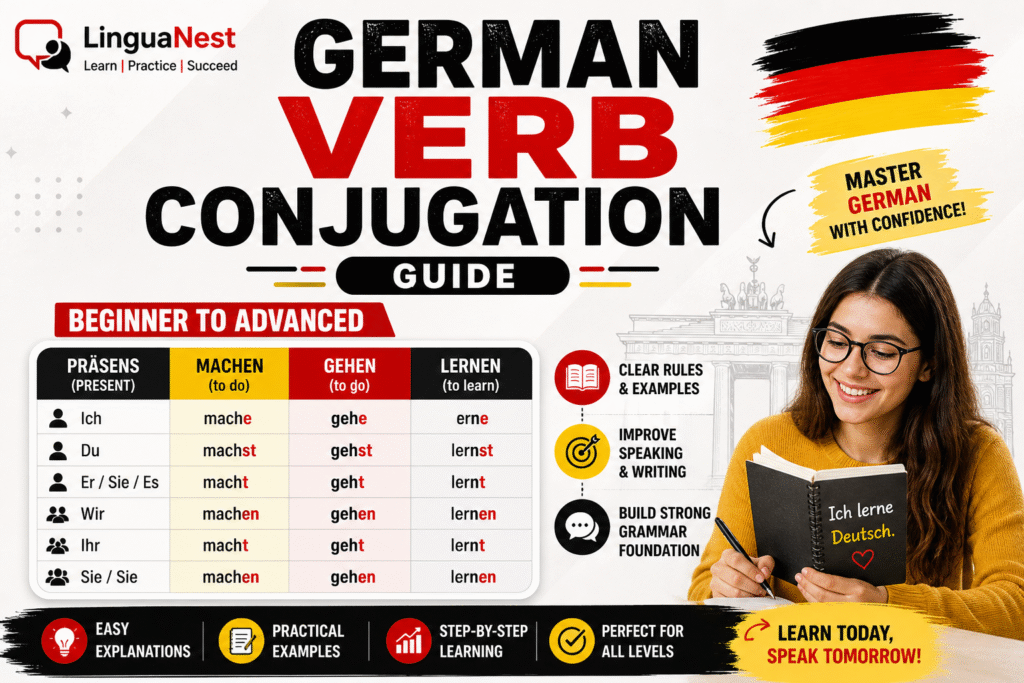
German Verb Conjugation Guide (Beginner to Advanced)
German verb conjugation is one of the most important aspects of learning the language. Whether you are a beginner or an advanced learner, mastering verbs will help you speak, write, and understand German more confidently.
1. What is Verb Conjugation?
Verb conjugation means changing the verb form based on the subject (I, you, he, etc.) and tense (present, past, future).
Ich gehe — I go
Du gehst — You go
Er geht — He goes
2. Present Tense (Präsens) — Beginner Level
The present tense is the first step in learning German verbs.
Regular Verb Example: “machen” (to do)
| Subject | Conjugation |
|---|---|
| Ich | mache |
| Du | machst |
| Er/Sie/Es | macht |
| Wir | machen |
| Ihr | macht |
| Sie | machen |
3. Irregular Verbs — Beginner to Intermediate
Some verbs change their stem when conjugated.
Example: “fahren” (to drive)
Du fährst
Er fährt
Notice the vowel change (a → ä).
4. Modal Verbs (Very Important)
Modal verbs are used to express ability, necessity, or desire.
- können — can
- müssen — must
- wollen — want
- sollen — should
- dürfen — may
Ich muss lernen. (I must study)
5. Past Tense (Perfekt) — Intermediate Level
The Perfekt tense is used in spoken German.
Structure:
Ich bin gegangen. (I went)
6. Future Tense (Futur I)
Used to talk about future actions.
7. Advanced: Subordinate Clauses
In advanced German, verbs often go to the end of the sentence.
8. Common Mistakes to Avoid
- Forgetting verb endings
- Wrong auxiliary verb (haben/sein)
- Incorrect word order
9. Tips to Master German Verbs
- Practice daily
- Use verbs in sentences
- Focus on high-frequency verbs
- Listen and repeat
Conclusion
German verb conjugation may seem complex, but with regular practice and the right approach, you can master it step by step.
Start with the present tense, move to past and future, and gradually learn advanced structures.
Master German Grammar Today 🇩🇪
Join expert-led German classes and improve your grammar, speaking, and fluency.
Start Learning