
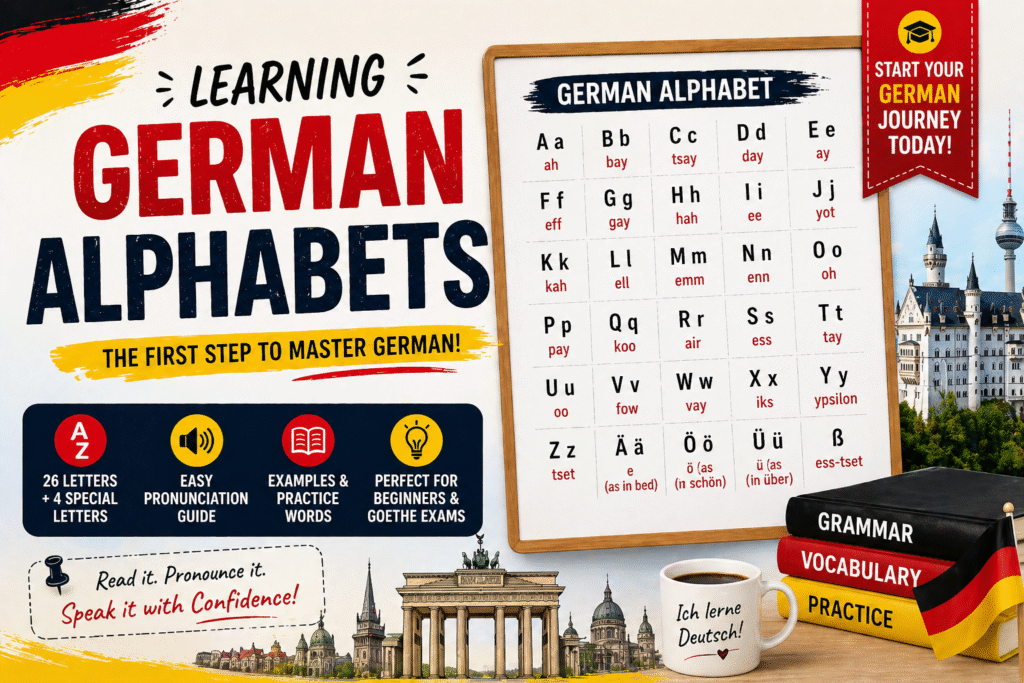
German Alphabet Made Easy: A Beginner’s Guide
Learning the German alphabet is the first step toward reading, writing, and speaking German confidently. If you are a beginner or preparing for Goethe A1, A2, B1, or B2 exams, understanding German letters and sounds will help you improve pronunciation from day one.
- The German alphabet with pronunciation
- Special German letters: Ä, Ö, Ü, and ß
- Common pronunciation rules
- Beginner words for alphabet practice
How Many Letters Are in the German Alphabet?
The German alphabet has the same 26 basic letters as English. However, German also uses special letters called Umlauts: Ä, Ö, Ü, and the letter ß, called Eszett or sharp S.
German Alphabet Chart with Pronunciation
| Letter | German Pronunciation | English Sound Hint |
|---|---|---|
| A | ah | like “a” in father |
| B | bay | like English B |
| C | tsay | often “ts” sound |
| D | day | like English D |
| E | ay | like “e” in they |
| F | eff | like English F |
| G | gay | hard G sound |
| H | hah | clear H sound |
| I | ee | like “ee” in see |
| J | yot | like English Y sound |
| K | kah | like English K |
| L | ell | like English L |
| M | emm | like English M |
| N | enn | like English N |
| O | oh | rounded O sound |
| P | pay | like English P |
| Q | koo | usually with U: “kv” sound |
| R | air | slightly rolled or throat R |
| S | ess | S or Z sound depending on word |
| T | tay | like English T |
| U | oo | like “oo” in food |
| V | fow | often sounds like F |
| W | vay | sounds like English V |
| X | iks | like “ks” |
| Y | üpsilon | used mostly in foreign words |
| Z | tset | like “ts” in cats |
Special German Letters: Ä, Ö, Ü and ß
These letters are very important because they can change the meaning and pronunciation of words.
| Letter | Name | Sound Hint | Example |
|---|---|---|---|
| Ä | A-Umlaut | like “e” in bed | Mädchen → girl |
| Ö | O-Umlaut | round lips and say “e” | schön → beautiful |
| Ü | U-Umlaut | round lips and say “ee” | Tür → door |
| ß | Eszett / sharp S | sounds like “ss” | Straße → street |
Important German Pronunciation Rules
- W sounds like English “V”: Wasser → water
- V often sounds like English “F”: Vater → father
- J sounds like English “Y”: ja → yes
- Z sounds like “ts”: Zeit → time
- CH has a special sound: ich → I
- SCH sounds like “sh”: Schule → school
- EI sounds like “eye”: mein → my
- IE sounds like “ee”: Liebe → love
Beginner German Words for Alphabet Practice
| German Word | Meaning | Practice Sound |
|---|---|---|
| Hallo | Hello | H sound |
| Danke | Thank you | A and E sounds |
| Ja | Yes | J = Y sound |
| Nein | No | EI sound |
| Schule | School | SCH sound |
| Ich | I | CH sound |
| Mädchen | Girl | Ä + CH sound |
Common Mistakes Beginners Make
- Pronouncing German letters exactly like English
- Confusing W and V
- Forgetting Umlaut sounds: Ä, Ö, Ü
- Pronouncing J like English J instead of Y
- Ignoring the difference between EI and IE
Quick Practice Exercise
Read these German words slowly and focus on the alphabet sounds:
- Hallo
- Danke
- Wasser
- Vater
- Zeit
- Schule
- Liebe
- Straße
Why Learning the German Alphabet Matters
A strong alphabet foundation helps you pronounce German words correctly, spell your name, understand listening audio, and speak with confidence. For Goethe exams, pronunciation and listening clarity are very important, especially at A1 and A2 levels.
Start Learning German the Right Way
Build your German foundation step-by-step with alphabet, pronunciation, grammar, vocabulary, and Goethe exam preparation.
Join German Classes