
Germany Permanent Residence for Indians: How Nurses, Ausbildung Graduates and Skilled Workers Can Settle
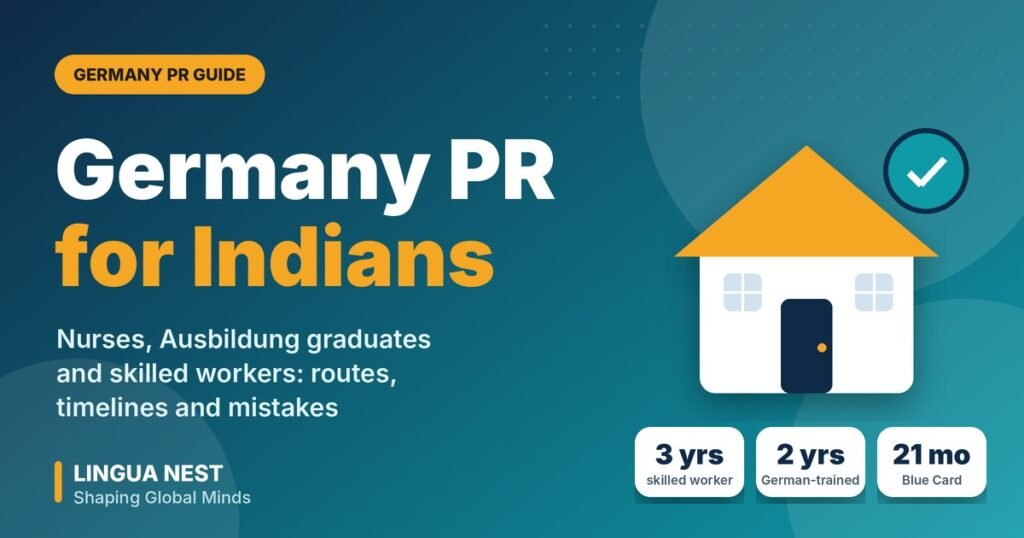
The time to a German settlement permit depends on your route: as little as 21 months for some degree holders, two years if you trained in Germany, and three years for most skilled workers.
You have passed the language exam, finished recognition or training, and started work in Germany. Sooner or later the next question arrives: can I stay here for good? For many Indian nurses, Ausbildung graduates and skilled professionals, the answer is yes, but the timeline depends on which door you came through and what you do while you are there.
This guide explains Germany permanent residence for Indians in plain language. It covers the settlement permit routes for nurses, Ausbildung graduates and skilled workers, the conditions everyone must meet, the mistakes that delay applications, and a point that matters especially for Indians: the difference between permanent residence and German citizenship.
What Does Permanent Residence Mean in Germany?
In everyday speech, “PR” in Germany usually means the settlement permit (Niederlassungserlaubnis). Unlike a temporary residence permit, it does not need to be renewed on a fixed date. The government portal Make it in Germany explains the settlement permit and its conditions in detail, and we summarise them below.
Two related terms often get mixed up with it:
- Permanent EU residence permit: a related option that generally needs five years of legal residence in Germany and at least 60 months of pension contributions, plus financial independence, sufficient German and living space.
- German citizenship: a different status altogether. It changes your nationality and passport, and for Indians it has an important side effect that we explain in the citizenship section below.
Germany Settlement Permit Routes at a Glance
| Who you are | Route | Time required | Pension contributions | German level |
|---|---|---|---|---|
| Skilled worker with a vocational qualification, including a recognised nurse | Standard skilled-worker route | 3 years on a qualifying permit | 36 months | B1 |
| Graduate of German vocational training or a German university | Shorter skilled-worker route | 2 years on a skilled-worker permit | 24 months | B1 |
| EU Blue Card holder (degree holders; not available to nurses) | Blue Card route | 27 months, or 21 months with B1 German | For that period | A1 at 27 months, B1 at 21 months |
| Spouse of a settlement-permit holder | Family route | At least 3 years of residence, working 20+ hours a week | — | B1 |
Figures come from the Make it in Germany settlement permit page, checked in October 2026. All routes also need the “Living in Germany” test and enough living space.
Nurses: Planning Your Settlement Permit
A nurse with a recognised qualification who works as a Pflegefachkraft falls under the standard skilled-worker route: three years on a qualifying permit, 36 months of pension contributions and B1 German, plus the conditions in the next section. Make it in Germany states clearly that the EU Blue Card does not apply to nursing professionals, so the shorter Blue Card timelines are not available to you.

⚠️ Watch-outs
- The law lists which permit types count towards the three years (skilled-worker permits). A permit issued only for recognition or an adaptation course is not on that list, so ask whether any earlier time counts.
- Gaps in pension contributions, for example during long unpaid breaks.
- Working at B1 level but never getting the certificate on paper.
✅ How to plan
- Write down the exact start date of your skilled-worker permit and add three years.
- Book your B1 or B2 exam early. Read our guides on German B1 and B2 for nurses and Goethe vs telc to choose your certificate.
- Keep your pension statements and payslips in one folder.
Ausbildung Graduates: The Faster Two-Year Route
This is the route Ausbildung students should keep in mind from day one. If you complete German vocational training (or a German degree), the law shortens the requirement to two years on a skilled-worker permit and 24 months of pension contributions, with B1 German, the “Living in Germany” test and sufficient living space.
How it usually unfolds
- You complete your Ausbildung on a training residence permit.
- You move onto a skilled-worker permit with a job in your trained profession.
- After two years on that permit, with the other conditions met, you can apply for the settlement permit.
New to the pathway? Start with our Ausbildung eligibility and salary guide, compare options in Bachelor’s vs Ausbildung, or visit our Ausbildung programme page.
Degree-Holding Skilled Workers: The EU Blue Card Shortcut
If you hold a university degree and work in a qualifying role, the EU Blue Card can shorten the road. Holders can apply for a settlement permit after 27 months of qualified employment with pension contributions, needing basic (A1) German. With B1 German, the period drops to 21 months.
- Blue Cards depend on a salary threshold that is updated regularly, so check the current figure on BAMF’s EU Blue Card page before you rely on this route.
- If you work on a different skilled-worker permit, the standard three-year route applies.
- Arrived on a Chancenkarte (Opportunity Card)? That card is a way in, not a PR route. Once you find qualifying work, you switch to a work permit and the clock above applies. See our Chancenkarte guide.
Conditions Everyone Must Meet
Beyond the time requirement, the standard skilled-worker route lists these conditions:
- Livelihood: you cover your living costs without state assistance.
- Pension contributions: 36 months, or 24 months on the shorter route.
- German language: B1 (A1 applies at the 27-month Blue Card mark).
- A qualifying job: work that your residence permit allows.
- “Living in Germany” test: a test on the legal and social system and way of life.
- Living space: enough space for you and your family members.
- Fee: up to roughly €150, depending on your status group. Your local authority confirms the exact amount.
Mistakes That Delay Your Settlement Permit
⚠️ Common mistakes
- Assuming every year in Germany counts, whatever the permit type.
- Counting from the day you landed instead of the date your qualifying permit began.
- Leaving the B1 certificate and the “Living in Germany” test to the last month.
- Not keeping pension statements, payslips and rental contracts.
- Relying on a four-year article from before the reform.
- Spending long periods outside Germany without checking the rules.
✅ Better habits
- Check the permit type on your card and ask whether it counts.
- Mark your eligibility date and set a reminder six months earlier.
- Pass B1 and the test early, and store the certificates safely.
- Download your pension statement every year and keep copies.
- Check the government portal, not forum posts, for the current rules.
- Talk to the authority before any long trip abroad.
Permanent Residence vs German Citizenship: What Indians Should Know
A settlement permit lets you live and work in Germany long term, but you remain an Indian citizen. German citizenship is a separate application with its own rules.
The German side
- Naturalisation again requires five years of legal residence. The three-year “fast-track” route introduced in 2024 was abolished in October 2025, according to the European Commission’s migration news service.
- Applicants must show sufficient German and financial independence.
- Germany’s 2024 reforms generally allow dual citizenship.
The Indian side
- Indian law does not allow dual citizenship. An Indian consulate FAQ explains that acquiring foreign citizenship means giving up Indian nationality and surrendering your Indian passport to receive a surrender certificate.
- The same FAQ says that the surrender or renunciation certificate is mandatory for an OCI (Overseas Citizen of India) application, and that you cannot apply for OCI and renunciation together.
Your Step-by-Step Settlement Permit Plan
- Identify your route. Standard (3 years), German-trained (2 years) or Blue Card (21 or 27 months).
- Mark your date. Take the start date of your qualifying permit and add the required time.
- Lock in German and the test. Get your B1 certificate and pass the “Living in Germany” test well before your date.
- Collect your proof. Pension statement, payslips or employment contract, rental contract, passport and permit card.
- Ask your Ausländerbehörde. Confirm which documents they want and whether any earlier permit time counts.
- Apply, then decide about citizenship. Citizenship needs five years and has consequences for your Indian citizenship, so decide with full information.
Frequently Asked Questions
How long does it take an Indian nurse to get permanent residence in Germany?
On the standard skilled-worker route it is three years on a qualifying skilled-worker permit, with 36 months of pension contributions, B1 German and the “Living in Germany” test. Time on permits issued only for recognition or an adaptation course may not count, so confirm your case with your local authority.
Can Ausbildung graduates get permanent residence faster?
Yes. After completing German vocational training, the requirement drops to two years on a skilled-worker permit and 24 months of pension contributions, with B1 German and the other conditions.
Does the EU Blue Card apply to nurses?
No. Make it in Germany states that the EU Blue Card does not apply to nursing professionals, so nurses use the standard skilled-worker route.
Is permanent residence the same as German citizenship?
No. A settlement permit is an unlimited residence title, while citizenship changes your nationality. Naturalisation requires five years of legal residence, sufficient German and financial independence, and the three-year fast-track route was abolished in October 2025.
Can Indians keep Indian citizenship after becoming German?
Germany generally allows dual citizenship, but India does not. According to an Indian consulate FAQ, acquiring foreign citizenship means surrendering your Indian passport and receiving a surrender certificate. OCI is a separate application, and the certificate is mandatory for it.
What happens if I leave Germany for a long period?
A residence permit can expire if you leave for a non-temporary reason or do not re-enter within six months, though the authority can extend that period. Exceptions apply to settlement permit holders with at least 15 years of lawful residence. Check with your authority before long absences.
Start your Germany journey on solid ground
Lingua Nest provides small-batch German training, exam preparation and placement guidance for nurses and Ausbildung applicants. Reaching B1 and B2 early makes every later step easier. We do not give legal advice or promise visas, because those decisions belong to the German authorities.
Book Free Counselling WhatsApp UsDisclaimer: This article is general information, not legal advice. It reflects official pages we read in October 2026. Immigration rules change, so confirm your own eligibility with your local foreigners authority or a qualified immigration lawyer before you apply.