
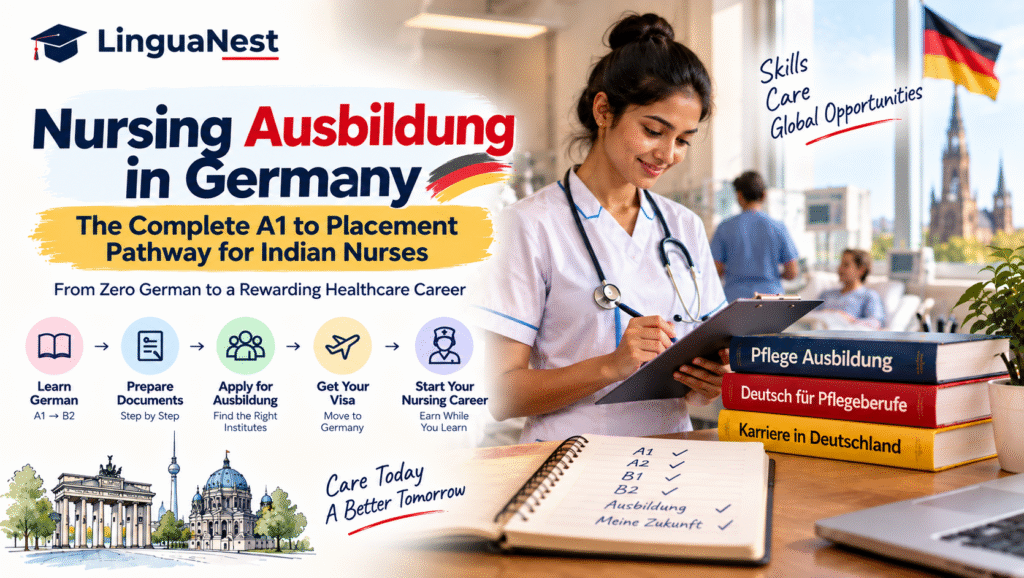
Nursing Ausbildung in Germany: The Complete A1 to Placement Pathway for Indian Nurses
✍️ By Lingua Nest Editorial Team | 📅 Last updated: September 2026 | ⏱ 10 min read
Photo: Mathurin NAPOLY / Unsplash

Germany’s ageing population has created one of the most sustained nursing shortages in Europe — and one of the clearest, most structured routes for Indian candidates to build a stable healthcare career abroad. Nursing Ausbildung is a three-year, fully paid vocational training programme that turns a complete beginner in German into a state-recognised nurse, with no tuition fees and a monthly stipend from day one of training.
What most guides skip is the part before the placement — reaching the language level nursing programmes actually require. This guide walks through the full journey: from zero German, through the language milestones, to a confirmed Ausbildung placement.
Nursing Ausbildung at a Glance
| Factor | Detail |
|---|---|
| Duration | 3 years, combining hospital training with vocational school |
| Cost | No tuition fees — candidates earn a monthly stipend throughout |
| Language Level | B1 typically required; B2 for faster direct-entry routes |
| Prior Nursing Background | Not required for the Ausbildung route — training starts from scratch |
| Qualification | State-recognised nursing qualification, valid across all 16 German states |
The Journey From Zero German to a Confirmed Placement
Build Your German From A1
Photo: Elsa Tonkinwise / Unsplash

You do not need any prior German to start this pathway. Structured training moves candidates through A1, A2, and B1 — and, for the faster direct-entry route, on to B2 — with dedicated speaking practice built in throughout, since nursing interviews and hospital communication depend heavily on spoken confidence, not just grammar.
Learn Medical & Workplace German Alongside Grammar
General B1/B2 German alone isn’t enough for a hospital floor — nursing communication runs on its own vocabulary: patient charts, medication names, symptom descriptions, and clear, calm communication under pressure. Building this alongside standard grammar training, rather than after it, means you arrive at your Ausbildung placement able to actually function on day one, not just pass an exam.
Clear a Readiness Screening
Photo: Cytonn Photography / Unsplash

Once you reach the required language level, a readiness screening checks that your spoken proficiency actually matches your certificate — hospitals rely on this to know a candidate can communicate confidently, not just pass a written exam. This stage typically covers a structured conversation, common interview questions, and basic role-play around patient interaction.
Employer Matching & Interviews
German hospitals and healthcare facilities actively recruit international nursing candidates, with dedicated pathways for Indian applicants at many major healthcare networks. Matching happens based on your language level, availability, and any location preferences, followed by employer interviews — typically conducted over video call before relocation.
Offer, Documentation & Visa
Once an employer confirms your placement, you’ll receive a training contract, followed by documentation support and the Ausbildung visa application. This is the same visa category covered in our Ausbildung application process guide, and processing timelines follow the same general pattern as any other Ausbildung route.
Relocation & Training Begins
You relocate to Germany and begin your three-year Nursing Ausbildung — combining supervised clinical work at your host hospital with theoretical study at vocational school (Berufsschule), earning a monthly stipend throughout.
What Happens After Qualification
- State-recognised nursing qualification valid across all 16 German states — not tied to a single region or employer.
- Full-time employment at any hospital, nursing home, or care facility in Germany.
- Career progression into specialised nursing, management, or further healthcare education.
- Permanent residency eligibility in Germany after five years, with a pathway to citizenship after further qualifying years.
- Family reunification — a spouse and children can join once you’re settled, which is where a documented German A1 level often becomes relevant for the accompanying family member’s own visa.
Frequently Asked Questions
Do I need a nursing background to start this pathway?
No. Nursing Ausbildung is designed as vocational training from the ground up — the clinical and theoretical nursing education happens during the three-year programme itself, not before it.
What German level do I actually need?
B1 is the commonly required minimum for the standard Ausbildung route, while some faster direct-entry pathways require B2. Either way, spoken confidence matters as much as the certificate itself, since hospital communication and the readiness screening both test live language use.
Is Nursing Ausbildung different from a nursing degree (BSc Nursing)?
Yes — Ausbildung is a three-year, no-tuition vocational training route with a stipend throughout, while a BSc Nursing degree is a longer university-based pathway. Ausbildung is generally the faster route into paid clinical work and independent income.
How is this different from just doing a German B1/B2 course on its own?
A general B1/B2 course builds language ability but doesn’t include medical vocabulary, workplace-specific communication, or the readiness screening hospitals expect. This pathway builds all three together, so your language training is aimed directly at the nursing placement rather than a generic certificate.
For broader guidance on the Ausbildung visa category itself, see Make it in Germany, the official German government portal for skilled professionals.
Ready to start your Nursing Ausbildung journey from A1? LinguaNest’s structured German language course builds your general and medical German together, with dedicated speaking practice designed for real hospital communication — both online and offline.