
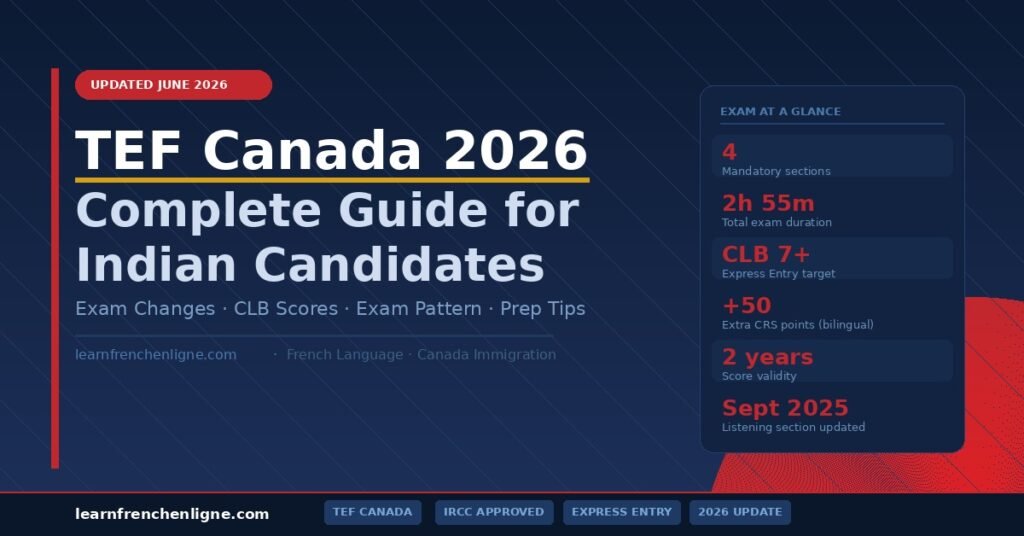

TEF Canada 2026: What Changed, What Didn’t & What Indian Candidates Must Know
If you are an Indian student or professional with Canada on your radar, you have almost certainly come across the TEF Canada exam — the Test d’Évaluation de Français that measures your French language ability for Canadian immigration. As Canada’s Express Entry draws grow increasingly competitive, a strong TEF Canada score can add up to 50 extra CRS points to your profile and unlock doors to permanent residency faster than almost any other single action.
But 2026 brings questions: what changed? What stayed the same? And what do Indian candidates specifically need to do right now? This comprehensive guide answers every one of those questions, drawing on the official IRCC guidelines and the latest updates from the exam body, CCI Paris Île-de-France (tefcanada.ca).
1. What Is TEF Canada? (A 2026 Refresher)

Indian students preparing for TEF Canada can reach CLB 7+ with structured online coaching.
TEF Canada (Test d’Évaluation de Français pour le Canada) is a standardized French proficiency examination administered by the Chambre de Commerce et d’Industrie de Paris Île-de-France (CCI Paris IdF). It is one of only two French language tests officially accepted by Immigration, Refugees and Citizenship Canada (IRCC) for Express Entry, Provincial Nominee Programs, and Canadian citizenship applications (the other being TCF Canada).
For IRCC purposes, all four sections must be taken on the same day:
- Reading Comprehension (Compréhension Écrite) — 60 minutes
- Listening Comprehension (Compréhension Orale) — 40 minutes
- Written Expression (Expression Écrite) — 60 minutes
- Oral Expression (Expression Orale) — 15 minutes
Total in-seat time is approximately 2 hours and 55 minutes. Results are published online roughly 4–6 weeks after the exam and are valid for two years from the test date for IRCC purposes.
2. TEF Canada Changes 2026: The One Confirmed Update
Despite rampant speculation online, there is exactly one confirmed structural change to TEF Canada for 2026 — and it applies specifically to the Listening section, effective 1 September 2025.
What Changed in the Listening Section
🔄 Listening Section Update (Effective 1 Sept 2025)
- Micro-trottoir questions (short street-interview audio clips) now offer 3 answer options instead of 4. This slightly narrows your decision-making and improves elimination odds.
- Double-play option: Certain interview audio segments can now be played twice, instead of once — giving a genuine safety net if you miss something on the first listen.
These changes apply only to specific question types within the listening section — not to all 40 questions. The standard listening questions retain their original single-play format. The double-play is a recovery mechanism, not a universal guarantee.
Old prep material warning: Practice tests that feature 4-option micro-trottoir questions are now outdated. Make sure your study resources reflect the September 2025 update. At LearnFrenchEnLigne, all our TEF Canada mock tests are updated to match the current format.
3. What Did NOT Change in TEF Canada 2026
This is equally important. Here is a complete breakdown of everything that remains the same:
| Component | Detail | Status |
|---|---|---|
| Number of Sections | 4 (Reading, Listening, Writing, Speaking) | Unchanged |
| Total Duration | ~2 hours 55 minutes | Unchanged |
| Reading | 40 MCQs, 60 minutes, no backtracking | Unchanged |
| Writing | 2 tasks (Task A: 25 min / Task B: 35 min) | Unchanged |
| Speaking | 2 topics, 15 minutes, live with examiner | Unchanged |
| Score Scales | Reading 0–300 / Listening 0–360 / Writing & Speaking 0–450 | Unchanged |
| CLB Mapping Logic | IRCC evaluates each skill independently, no combined total | Unchanged |
| Exam Validity | 2 years from result date | Unchanged |
| Retake Rule | Minimum 20-day gap between sittings; no cap on total attempts | Unchanged |
| Exam Mode | Computer-based | Unchanged |
| Micro-trottoir (Listening) | Now 3 answer options instead of 4 | Updated Sept 2025 |
| Interview segments (Listening) | May now be played twice | Updated Sept 2025 |
4. Full TEF Canada Exam Pattern 2026 — Section by Section

TEF Canada is fully computer-based. Practising on screen — not paper — is essential.
Section 1 — Reading Comprehension (60 minutes)
40 multiple-choice questions spread across approximately 51 screens. Each question has 4 answer choices. No backtracking is allowed, so pacing discipline is critical. Tests your ability to understand written French across varied contexts — news, professional, everyday, and literary.
Section 2 — Listening Comprehension (40 minutes)
40 multiple-choice questions. Standard questions use single-play audio with 4 options. Micro-trottoir clips (short street interviews) now have 3 options. Some interview segments may play twice. Tests comprehension of conversations, announcements, and formal interviews in various French accents.
Section 3 — Written Expression (60 minutes)
Task A (25 minutes): Write a factual, informational, or narrative text of at least
80 words — typically a letter, email, or report.
Task B (35 minutes): Write an argumentative text of at least 200 words.
Both tasks are graded by human examiners for vocabulary, grammar, coherence, and register.
Section 4 — Oral Expression (15 minutes)
Section A (5 min): Data collection task — you interact with the examiner to gather
specific information.
Section B (10 min): Argumentative task — you present and defend a position.
The session is recorded for double assessment, so consistency and clarity throughout matter.
5. CLB Scores & Express Entry Points for 2026
Your TEF Canada scores convert to Canadian Language Benchmark (CLB) levels which directly affect your Comprehensive Ranking System (CRS) score. IRCC evaluates each of the four skills independently — a high score in one section cannot compensate for a low score in another.
Minimum scores required for CLB 7 (the Express Entry threshold):
6. Why TEF Canada Matters for Indian Immigration Aspirants in 2026

For Indian Express Entry candidates, French proficiency is now a decisive advantage.
Canada has long been among the most popular immigration destinations for Indians, and French proficiency has quietly become one of the most powerful strategic levers in an increasingly competitive Express Entry landscape. Here is why TEF Canada 2026 matters more than ever:
- CRS Score Boost: Up to 50 additional points for bilingual candidates dramatically improves Invitation to Apply (ITA) odds.
- Francophone Streams: Special immigration pathways — including the Francophone Mobility Program and targeted PNP draws — have lower cutoffs for French speakers.
- Dual Language Advantage: English + French candidates are classified as high-value immigrants, especially in Ontario, New Brunswick, and Quebec.
- Provincial Nominee Programs: Several provinces actively target French speakers with dedicated draws that bypass national CRS cutoffs.
- Citizenship Applications: TEF Canada results are accepted for citizenship applications — with a 2-year validity, align your test date with your naturalization timeline.
7. Proven Preparation Tips for Indian Candidates — Section by Section
🎧 Listening — The Updated Section
The September 2025 listening update means your preparation needs a specific shift. Here is what works:
- Practice micro-trottoir clips daily — street conversations, informal interviews, and rapid Canadian/Québécois French dialogue.
- With 3 options instead of 4, practice instantly eliminating the clearly wrong answer, then choosing between the remaining two.
- Build an “attention reset” habit: if you miss a phrase, move on immediately — don’t dwell. The double-play on interview segments is a bonus, not a fallback strategy.
- Expose yourself to multiple French accents: Parisian, Canadian, Québécois, and African French all appear in the exam.
- Do all listening practice with single-play audio — replaying during practice builds a habit you cannot use on exam day.
👁️ Reading — No Changes, But Pacing Is Everything
- Run 60-minute timed drills regularly — no backtracking means every decision must be made in the moment.
- Build skimming and scanning skills for longer texts. You have roughly 90 seconds per question.
- Expand vocabulary around high-frequency topics: health, technology, work, environment, and social issues.
✍️ Written Expression — Argumentation Wins Points
- Task A: Practice factual letters and emails. Keep structure clear — greeting, purpose, details, closing.
- Task B: Write argumentative texts with logical progression. Target 10–15% above the 200-word minimum to signal fluency.
- Revise French linking words, transition phrases, and formal register weekly (par conséquent, en revanche, c’est pourquoi…).
🗣️ Oral Expression — Confidence & Structure
- Section B (persuasion/argumentation) rewards structured, confident delivery. Practise debate-style speaking on current topics.
- Record yourself and listen back for clarity, pronunciation, and natural rhythm.
- Speak fluently over perfectly — long pauses hurt your score more than minor grammatical slips.
Want a structured study plan tailored to your current French level? LearnFrenchEnLigne’s TEF Canada courses include section-specific mock tests updated to the 2026 format, live feedback sessions, and personalised CLB target tracking.
8. Common Mistakes Indian Candidates Make — and How to Avoid Them
| Mistake | Why It Hurts | The Fix |
|---|---|---|
| Using outdated prep material | 4-option micro-trottoir questions no longer exist; practising with them creates a false sense of readiness | Verify that your practice tests reflect the September 2025 listening update |
| Ignoring Canadian French accents | Many Indian students learn European French but struggle with Québécois accent in the listening test | Add dedicated Canadian French audio to your daily routine from month one |
| Undervaluing Written Expression | The 200-word argumentative Task B is where marks are lost most often — it requires structured weekly practice | Write one Task B response every week, get feedback, and review examiner criteria |
| Not practising in timed conditions | Reading without backtracking and writing in 60 minutes feel completely different under pressure | Run full timed mock sessions monthly, not just individual section drills |
| Booking before ready | With a 20-day retake rule and non-refundable fees, an underprepared sitting wastes time and money | Take at least two full mock exams and consistently hit your CLB target before booking |
| Entering raw scores in Express Entry | IRCC requires the “Old Score Equivalence” column — raw scores will produce incorrect CLB calculations | Always use the Équivalence ancien score column from your results certificate |