
Reflexive Verb
Sich freuen, sich waschen, sich interessieren — German leans on reflexive verbs far more than English does. Here’s how the pronouns work and when to use which case.
Sich freuen, sich waschen, sich interessieren — German leans on reflexive verbs far more than English does. Here’s how the pronouns work and when to use which case.
Können, müssen, dürfen, wollen, sollen, mögen — six small verbs that carry an enormous amount of meaning. Here’s how to conjugate them, tell them apart, and use them naturally.
German Modal Verbs: The Complete Guide Read More »
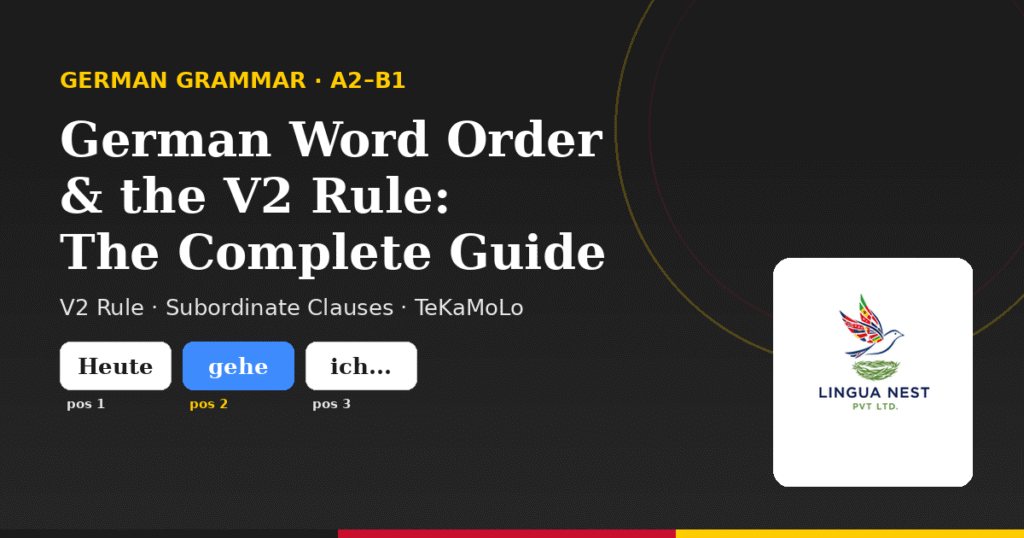
Why does the verb sometimes jump to the end of a German sentence? Here’s the logic behind the V2 rule, subordinate clauses, and the word order patterns native speakers use without thinking.
German Word Order & the V2 Rule Read More »
If you’ve been told to just “memorize the gender with every noun,” you’ve probably also noticed that’s easier said than done — especially once your vocabulary passes a few hundred words. Here’s the good news: German noun gender isn’t actually random. Instead, a large share of nouns follow predictable patterns based on their ending or their meaning, even though it looks random at first. This guide therefore walks through the patterns that hold up often enough to be useful, along with the well-known exceptions and the habits that helped learners in Linguanest’s German A1 course stop guessing and start recognizing.
Der, Die, Das: How to Guess German Noun Gender Read More »
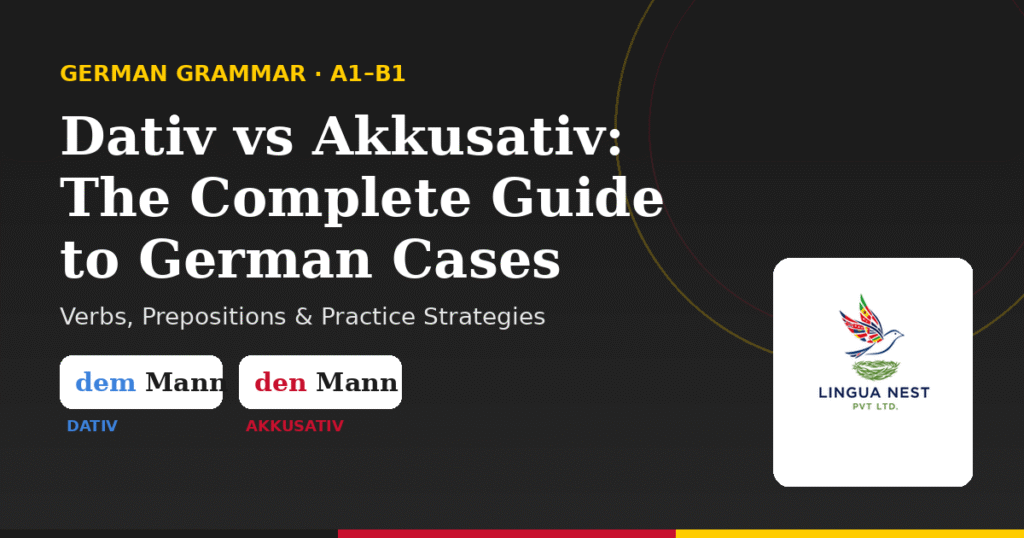
Every German sentence with an object is really answering a question about that object. If the object is the thing directly receiving the action — the thing being seen, bought, eaten, or built — that’s Akkusativ, the direct object. If the object is the person or thing the action happens for or to, on the side, that’s Dativ, the indirect object. In English we usually show this with word order or “to”: “I give the book to my friend” — in German, the article itself changes instead: Ich gebe meinem Freund das Buch.
Dativ vs Akkusativ: The Complete Guide to German Cases Read More »
whenever an adjective sits right in front of a noun, it needs an ending (-e, -er, -es, -en, or -em). Which one depends on the noun’s gender, its case in the sentence, and what kind of article, if any, comes before it. But if the adjective comes after the noun, in a sentence like Der Kaffee ist gut, it stays exactly as it is — no ending, no exceptions. Compare that to der gute Kaffee, where the adjective now sits before the noun and suddenly needs one.
German Adjective Endings: The Complete Guide with Tables & Examples Read More »
Welcome to the world of falsche Freunde — false friends. These are words that look exactly like an English word, sound like they should mean the same thing, and then betray you completely. They’re the reason A1 students confidently say something in German that means the opposite of what they intended — and the reason B1 students still slip up in the Goethe exam. Here’s your survival guide, with a few puns thrown in so the words actually stick.
German False Friends: The Words That Are Lying to You Read More »
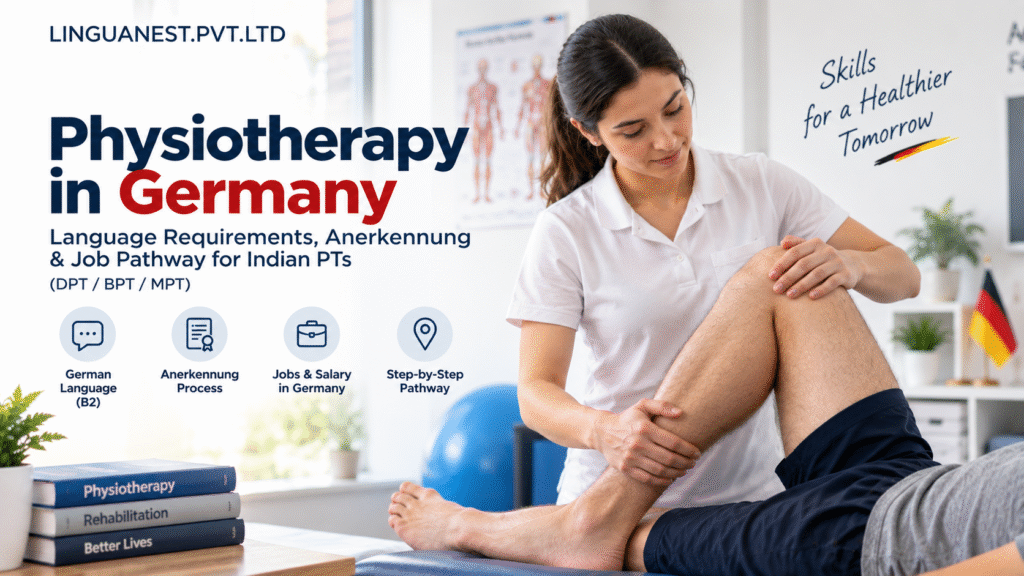
Every conversation about Indian healthcare workers going to Germany seems to start and end with nurses. Physiotherapists rarely get mentioned, yet Germany’s rehabilitation and physiotherapy sector is short-staffed for the same reason nursing is: an ageing population that needs far more hands-on care than the country can currently supply. For an Indian BPT or MPT graduate, that shortage translates into a real, well-paid, and comparatively fast pathway abroad — provided you understand two words that decide almost everything: B2 and Anerkennung.
This guide walks through exactly what those two words mean for you, what the job actually pays, and what the realistic timeline looks like from your first German class to your first payslip in Germany.

If you have spent any time researching how to move to Germany without a job offer already in hand, you have run into one word again and again: Chancenkarte. Launched under Germany’s Skilled Immigration Act, the Chancenkarte — officially the Opportunity Card — lets skilled Indians enter Germany for up to a year to job-hunt on the ground, instead of waiting in India for an employer to sponsor them first.
The catch is that it is not a “walk-in” visa. You either qualify automatically through a fully recognised qualification, or you have to score at least six points on a scale that weighs your education, work experience, language level, age, and ties to Germany. This guide breaks down exactly how those points are calculated, what the base requirements are regardless of your score, and how to apply from India in 2026 — plus where the Chancenkarte fits next to routes like the Ausbildung and the EU Blue Card.
Chancenkarte (Germany Opportunity Card): Complete Points Guide for Indians (2026) Read More »

Updated for 2026. If you’ve typed “German translator” into Google and landed here while also wondering whether you should just learn German instead — you’re not confused for no reason. The two searches look similar, but they solve completely different problems. Get this wrong and you either pay for a service you didn’t need, or you spend eight months in a classroom for something a certified translator could have handled in three days. This guide clears up exactly which one applies to your situation.
Do You Need a German Translator or Just B1 German? Clearing Up the Confusion Read More »