
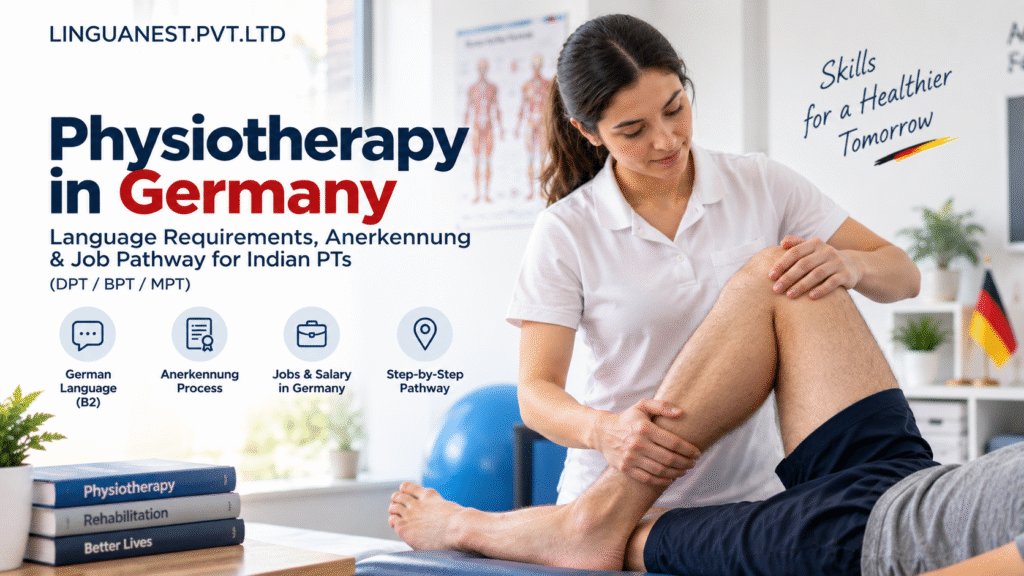
Physiotherapy in Germany: Language Requirements, Anerkennung & Job Pathway for Indian PTs (DPT/BPT/MPT)
Every conversation about Indian healthcare workers going to Germany seems to start and end with nurses. Physiotherapists rarely get mentioned, yet Germany’s rehabilitation and physiotherapy sector is short-staffed for the same reason nursing is: an ageing population that needs far more hands-on care than the country can currently supply. For an Indian BPT or MPT graduate, that shortage translates into a real, well-paid, and comparatively fast pathway abroad — provided you understand two words that decide almost everything: B2 and Anerkennung.
This guide walks through exactly what those two words mean for you, what the job actually pays, and what the realistic timeline looks like from your first German class to your first payslip in Germany.
Why Germany Needs Indian Physiotherapists Right Now
Germany’s population is one of the oldest in Europe, and demand for rehabilitation, orthopaedic, and geriatric physiotherapy is rising faster than German training institutes can produce graduates. Hospitals, outpatient practices (Praxis für Physiotherapie), and rehabilitation clinics across the country are actively recruiting from abroad, and Indian BPT/MPT graduates are increasingly on their shortlist — provided the two boxes below are ticked.
Step 1: The German Language Level Physiotherapists Actually Need
Why B2, not B1, is the real target
Nursing conversations in India revolve around B1/B2. For physiotherapists, the honest target is B2. You are working one-on-one with patients, explaining exercises, understanding pain descriptions, and writing treatment notes — all of which require a level of spoken and written fluency that B1 does not reliably give you. Most German employers and the recognition authorities list B2 as their expected level for the profession, and a handful of assistant-level roles during the recognition period accept B1, but treat that as the floor, not the goal.
Realistic timeline from zero to B2
Starting from scratch, most learners need 9 to 14 months of structured classes to reach a stable B2, depending on how many hours a week they can commit and whether classes include exam-specific practice. Trying to compress this timeline usually backfires at the Anerkennung stage, where assessors expect genuine fluency, not a certificate obtained through last-minute cramming.
Step 2: Anerkennung — Getting Your BPT/MPT Recognised in Germany
Anerkennung is Germany’s legal recognition process for foreign professional qualifications. For a regulated profession like physiotherapy, you cannot practise — or even use the protected title “Physiotherapeut/in” — until your Indian degree has been formally assessed as equivalent to the German training standard.
Who reviews your file
Your application goes to the competent state authority (the Landesamt or Regierungspräsidium) in whichever German state your future employer is based in — not a single national body. Each state runs the same core process, called the Gleichwertigkeitsprüfung (equivalence assessment), but processing times and documentation quirks vary slightly by state.
What the assessors are comparing
German physiotherapy training is typically structured around roughly 2,900 hours of theoretical and practical coursework plus around 1,600 hours of supervised clinical training. Your BPT or MPT transcript, internship logbook, and course syllabus are compared point-by-point against this structure to check for gaps in either theory hours or clinical exposure.
If there’s a gap: adaptation period or knowledge exam
If the authority finds your training broadly equivalent, you receive full recognition and the protected title. If there are meaningful gaps, you’re offered a choice between an Anpassungslehrgang (a supervised adaptation placement, legally capped at up to three years but usually far shorter in practice) or a Kenntnisprüfung (a knowledge examination covering the specific gap areas). Most Indian BPT graduates end up needing one or the other for at least part of their file — it is the norm, not a red flag on your application.
Step 3: Documents You’ll Need to Start the File
- Degree certificate and complete academic transcripts (BPT/MPT), translated by a certified translator
- Internship/clinical training logbook with hours clearly documented
- Detailed course syllabus from your college, ideally with an official seal
- Updated CV in the German (Lebenslauf) format
- Valid passport and passport-style photographs
- B2 German certificate (Goethe, TELC, or ÖSD — all are generally accepted)
- Police clearance certificate, where the employer or state requests one
Step 4: Job Offer, Interview & Visa
Once your documentation is in order and your German is at working B2, the sequence is usually: employer shortlisting and an online interview, a signed job contract (which strengthens your Anerkennung file), and then either a work visa or an Opportunity Card (Chancenkarte) if you want to job-hunt from inside Germany rather than from India. Candidates already holding a job contract typically move straight to the work visa route, since it is faster than the points-based Chancenkarte.
What you actually earn
Pay depends on whether you’re working as a fully recognised physiotherapist or as an assistant while your Anerkennung file is still being processed.
| Stage | Typical Monthly Salary (Gross) | What You’re Doing |
|---|---|---|
| Assistant, recognition in progress | Approx. €1,800 | Working under supervision while the state authority reviews your file |
| Newly recognised physiotherapist | Approx. €2,500 – €3,000 | Practising independently under the protected “Physiotherapeut/in” title |
| Experienced / specialised (e.g. sports, neuro) | €3,000+ | Senior clinical roles, private practices, sports rehabilitation centres |
Ausbildung vs Direct Recognition: Which Path Is Yours?
These two routes get mixed up constantly, so it’s worth separating them clearly.
| Direct Recognition (Anerkennung) | Ausbildung (Vocational Training) | |
|---|---|---|
| Who it’s for | You already hold a BPT/MPT or equivalent | You have no physiotherapy qualification yet |
| Duration in Germany | None required — assessment is document-based (plus adaptation period if needed) | Full training programme, typically 3 years |
| Earn while you go? | Yes, often as an assistant during any adaptation period | Yes, Ausbildung pays a monthly stipend throughout training |
| Fastest route to a paid job? | Usually yes, if your file has minimal gaps | Slower, since it starts training from zero |
If you’re a final-year or graduated BPT/MPT student, recognition is usually the more direct route because you are building on a qualification you already hold. Lingua Nest’s Ausbildung in Germany programme is built for candidates going the vocational-training route in other sectors, while our German language training for healthcare pathways follows the same B1→B2 structure used for our German Nurse Placement programme, adapted for physiotherapy vocabulary and clinical terminology.
Realistic Timeline: German Class to First Payslip
Combining language training, documentation, Anerkennung review, and visa processing, most candidates should plan for roughly 14 to 20 months from their first German class to their first day on a German ward or clinic floor. Candidates who begin document preparation (transcripts, translations, internship logs) alongside their language classes — rather than only after reaching B2 — tend to move through the later stages noticeably faster.
How Lingua Nest Can Help
Our German training follows the same small-batch, exam-focused structure we use across all our language programmes — A1 through B2, with mock exams on the PrepMyFuture platform and daily listening/speaking practice on 7Speaking. If you’re weighing the Goethe B2 route for your Anerkennung file, our Goethe B2 course guide and our TestDaF vs Goethe comparison are good next reads. If you are also exploring language-led immigration pathways, you can explore Lingua Nest for structured foreign-language training and career-focused language programmes.
Build your German pathway with Lingua Nest
Start with the right German level, build exam confidence, and prepare for a Germany-focused career pathway.
Frequently Asked Questions
Is B1 German enough for a physiotherapist job in Germany?
B1 can get you into some assistant-level roles while your Anerkennung is being processed, but B2 is the level most employers and state authorities expect for independent practice. Treat B1 as a stepping stone, not the destination.
Can final-year BPT/MPT students start the process before graduating?
Language training can start immediately — there’s no reason to wait. Document submission for Anerkennung, however, generally requires your final degree certificate, so that step waits until after your results are out.
What’s the difference between a work visa and the Chancenkarte for physiotherapists?
A work visa is used once you already have a signed job contract. The Chancenkarte (Opportunity Card) is a points-based visa that lets you enter Germany to search for a job in person, which suits candidates who haven’t secured an offer from India yet.
Is the physiotherapy pathway easier than the nursing pathway?
Neither is “easier” exactly, but physiotherapy recognition is often more document-driven and less bottlenecked than nursing recognition, since the applicant pool from India is smaller. The language requirement (B2) and the core Anerkennung logic are otherwise very similar.
Sources referenced for the Anerkennung process, training-hour structure, and salary ranges include Germany’s official skilled-worker portal Make it in Germany, the German physiotherapy professional association’s recognition guidance, and current job listings for internationally trained physiotherapists in Germany. Figures are gross monthly salary estimates and will vary by state, employer, and experience.