
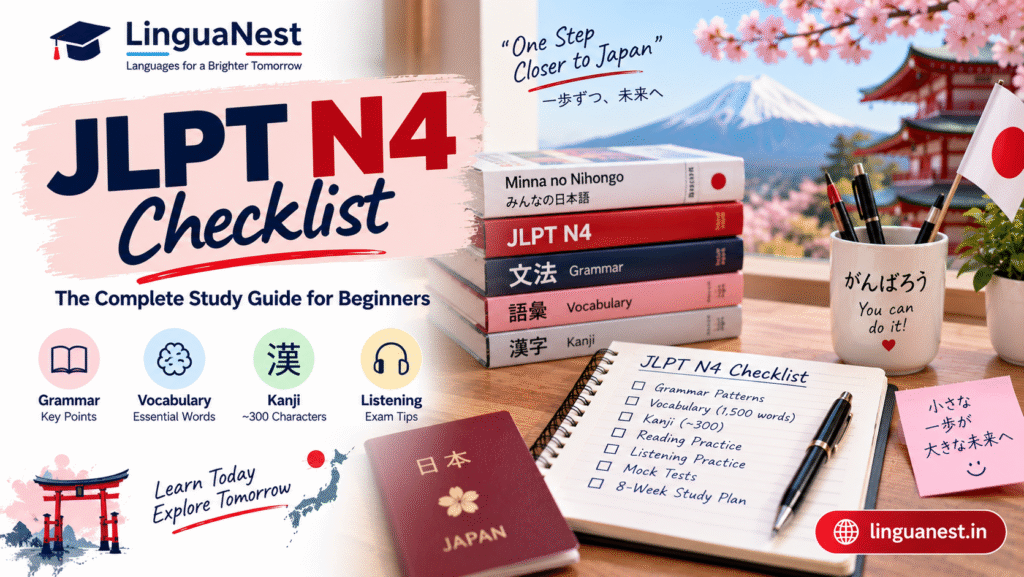
JLPT N4 Complete Checklist 2026 : Grammar, Vocabulary, Kanji & 8-Week Study Plan

The JLPT N4 (Japanese-Language Proficiency Test, Level 4) is the second-easiest tier of Japan’s official language exam, but it’s also where many learners hit their first real wall — verb conjugation patterns multiply, kanji stop being optional, and listening speed picks up noticeably from N5. This guide gives you a complete, checklist-style breakdown of everything N4 actually tests, plus a realistic 8-week plan to get there, so you always know exactly what’s left to cover.
What Does the JLPT N4 Level Actually Test?
N4 sits above N5 (absolute beginner) and below N3 (intermediate). At this level, examiners expect you to understand basic Japanese used in everyday situations and to follow slightly more complex conversations and short passages, provided they’re spoken at a natural but not overly fast pace. The exam is split into three sections: Vocabulary & Grammar, Reading, and Listening — and you need a passing score in each section, not just an overall average.
The Complete JLPT N4 Checklist
1. Grammar Points You Should Recognize on Sight
N4 grammar builds directly on N5’s foundation, adding structures for reasoning, obligation, and connecting ideas across sentences. Core patterns to check off include:
- Plain (dictionary/nai) form usage in casual speech and connecting clauses
- Te-form functions beyond simple linking: ~てもいい (permission), ~てはいけない (prohibition), ~ている (ongoing state)
- Conditional forms: ~たら, ~ば, and ~と for “if/when”
- Giving reasons: ~から and ~ので
- Expressing ability and potential: ~ことができる and potential verb forms
- Expressing intention and plans: ~つもり and ~ようにする
- Comparisons: ~より and ~ほど
- Passive and causative verb forms in basic contexts
2. Vocabulary Target
3. Kanji You Need to Know
N4 typically expects familiarity with around 300 kanji (cumulative with N5), including both the reading and the practical meaning. Focus your review on kanji that show up in compound words rather than memorizing characters in isolation — a kanji you can use in three different words is worth more than one you can only recognize alone.
4. Reading Comprehension Skills
Expect short passages (100–200 characters) such as notices, simple emails, and short narrative texts. The checklist here is less about vocabulary and more about speed: can you extract the main point of a paragraph without translating every word in your head?
5. Listening Comprehension Skills
Audio at N4 moves at a natural conversational pace. Train your ear on dialogues involving directions, shopping, scheduling, and simple opinions — these are the situational contexts N4 listening sections favor most.

8-Week JLPT N4 Study Plan
| Week | Focus | Milestone |
|---|---|---|
| 1–2 | Review all N5 grammar + start N4 te-form extensions | Comfortable with ~てもいい / ~てはいけない |
| 3–4 | Conditionals (~たら, ~ば, ~と) + 80 new kanji | Can form basic conditional sentences unprompted |
| 5 | Reasoning (~から, ~ので) + potential/ability forms | Can explain a simple reason in speech |
| 6 | Comparisons + passive/causative basics + 80 more kanji | Recognize passive forms in reading passages |
| 7 | Full-length listening practice + timed reading drills | Complete a full reading section within time limit |
| 8 | Full mock exams under real time conditions | Score consistently above the pass threshold in practice tests |
Common Mistakes N4 Candidates Make
- Treating kanji and vocabulary as separate tasks: learning a word’s sound without its kanji form (or vice versa) means relearning it twice later.
- Skipping listening practice until the last week: listening ability improves slowly and steadily — it can’t be crammed the way vocabulary can.
- Translating word-by-word during reading: this is too slow for N4’s time limits; practice reading for gist first, detail second.
- Ignoring the per-section pass requirement: a strong vocabulary score can’t compensate for a weak listening score — each section must clear its own minimum.
Related Learning Resources
If you’re building a full language-learning routine rather than studying Japanese in isolation, these related guides are worth a look:
- LinguaNest Blog — Language Learning Guides & Articles — more structured lessons and practice tools for learners tackling multiple languages alongside Japanese.
Sources and Official References
- Japan Foundation & Japan Educational Exchanges and Services — Official JLPT Site — the official body administering the JLPT, with level descriptions and past test summaries.
- The Japan Foundation — official cultural and educational organization overseeing Japanese language proficiency standards abroad.
Track your N4 progress week by week, and revisit this checklist every Friday to confirm you’re on pace for your target test date.