
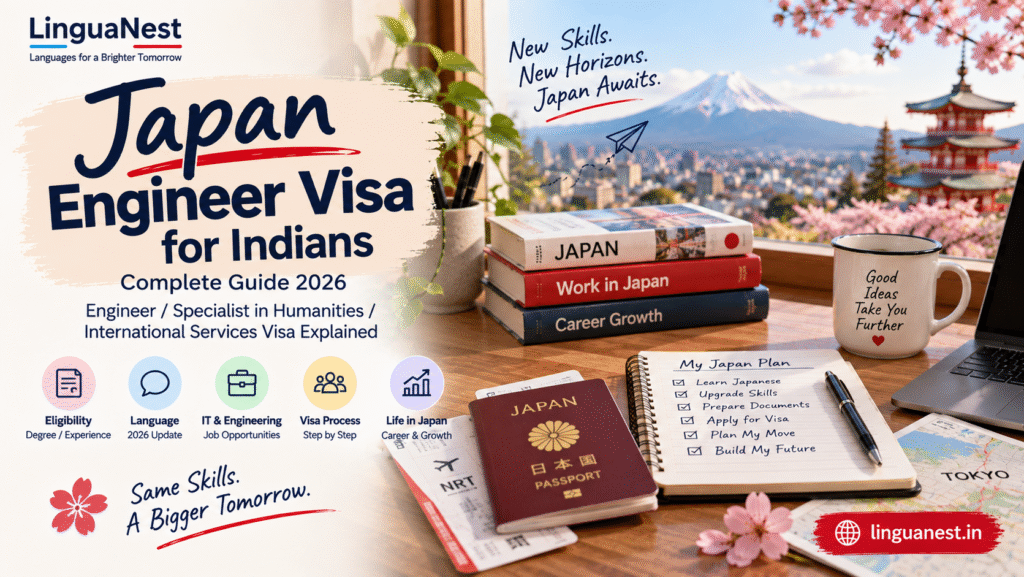
Japan Engineer Visa Guide for Indians: The Engineer/Specialist in Humanities/International Services Route Explained (2026 Update)
✍️ By Lingua Nest Editorial Team | 📅 Last updated: September 2026 | ⏱ 10 min read
Photo: Marty Finney / Unsplash

If you’re an Indian software engineer, IT professional, or business specialist eyeing a career in Japan, there’s a good chance your route in is the Engineer/Specialist in Humanities/International Services visa — Japan’s most common white-collar work visa, currently held by roughly 475,000 foreign nationals. For years, this was known as one of the more accessible professional visas: a relevant degree, a job offer, and Japanese language ability was little more than a bonus.
That changed in 2026. Japan’s Immigration Services Agency introduced a language-proficiency rule for the first time in this visa’s history — and it directly affects how Indian applicants should prepare. This guide breaks down exactly what the visa covers, who qualifies, and what’s genuinely new.
Quick Facts: Engineer/Specialist in Humanities/International Services Visa
| Factor | Detail |
|---|---|
| Who It’s For | IT engineers, software developers, business specialists, translators, marketers, HR & finance professionals |
| Degree Requirement | Bachelor’s degree related to the job, OR 3–10 years of relevant work experience (varies by role) |
| Salary Rule | Must be paid on par with a Japanese national doing the same role |
| Visa Duration | 1, 3, or 5 years — renewable indefinitely if requirements continue to be met |
| 2026 Update | New Japanese-language proof (JLPT N2 / CEFR B2) now required for customer-facing roles at smaller sponsoring companies — details below |
What Is the Engineer/Specialist in Humanities/International Services Visa?
Despite its long name, this is a single residence status that bundles three categories of white-collar work — grouped together because they share the same underlying eligibility framework:
- Engineer: software engineers, mechanical and electrical engineers, civil engineers, data scientists, and applied researchers.
- Specialist in Humanities: roles built on knowledge of law, economics, business administration, accounting, marketing, planning, HR, or finance.
- International Services: work that draws on a foreign cultural or linguistic background — translation, interpretation, private-sector language teaching, and similar roles.
It’s worth noting this is a fundamentally different route from the Specified Skilled Worker (SSW) and TITP programs, which target vocational and industrial roles like construction, manufacturing, and caregiving. If you’re a degree-holding professional rather than a skilled tradesperson, this visa — not SSW — is almost certainly your route.
Who Can Apply? Eligibility at a Glance
1. Degree or Work Experience
You generally need a bachelor’s degree in a field related to your intended job. If you don’t have a relevant degree, most roles accept 3 years of directly relevant work experience for International Services roles, or up to 10 years for Engineer and Specialist in Humanities roles — the exact threshold depends on the specific job type.
2. A Job Offer That Matches Your Background
Immigration screens closely for consistency between your degree or experience and the actual duties of the job. A mismatch — say, a mechanical engineering degree paired with a marketing role — is one of the most common reasons applications get delayed or rejected.
3. Employer Sponsorship & Salary Parity
Your employer must sponsor a Certificate of Eligibility (COE) on your behalf before you apply for the visa itself at a Japanese embassy or consulate. You must also be paid a salary equal to what a Japanese national would earn for the same work — this isn’t published as a fixed number, but it rules out below-market compensation.
The 2026 Update: A New Japanese Language Requirement
Photo: stable pattern / Unsplash

Here’s the change every prospective applicant needs to understand: starting 15 April 2026, Japan’s Immigration Services Agency introduced revised screening criteria for this visa for the first time since its creation. Previously, there was no formal language requirement at all — a strong degree and a valid job offer were enough, even with zero Japanese ability.
Under the new rule, if your role is primarily customer-facing or language-dependent — think interpretation, translation, sales involving client communication, or hotel front-desk work — and your sponsoring employer falls into Immigration’s Category 3 or 4 (generally smaller or newer companies, as opposed to large listed corporations), you must now prove Japanese ability equivalent to CEFR B2. That standard can be met through:
- JLPT N2 or higher
- BJT (Business Japanese Proficiency Test) score of 400 or above
- Graduation from a Japanese university or vocational college
- Completion of compulsory education plus high school in Japan
Two important exceptions: this requirement does not apply to purely technical or back-office roles where Japanese communication isn’t central to the job, and it does not apply to applicants sponsored by Category 1 or 2 employers (large or publicly listed companies), who remain exempt from this specific rule.
In practice, this means a backend software engineer at a large listed firm may still qualify with minimal Japanese. But a business development, sales, or client-facing IT consulting role at a smaller company now effectively requires N2-level Japanese — a level that used to be “recommended” and is now, for many applicants, mandatory.
You can review the official announcement directly on the Immigration Services Agency of Japan’s website.
Engineer/Specialist Visa vs SSW: Which Route Fits You?
| Factor | Engineer/Specialist Visa | SSW Visa |
|---|---|---|
| Best suited for | Degree-holding professionals — IT, engineering, business, translation | Skilled tradespeople — manufacturing, construction, caregiving, hospitality |
| Japanese language requirement | None historically; now N2/B2 for customer-facing roles at smaller companies (2026+) | JLPT N4 minimum, always required |
| Maximum duration | Renewable indefinitely if criteria are met | Up to 5 years (longer under SSW Type 2) |
For a deeper comparison of SSW and TITP specifically, see our guide on understanding SSW and TITP for working in Japan.
How Indian IT Professionals & Engineers Can Prepare
Photo: Kelly Brito / Unsplash

- Start Japanese early, even if your target role seems exempt. Category exemptions can change, and N2-level Japanese dramatically widens which companies and roles you can realistically apply to.
- Align your resume with your degree field. Since immigration checks the degree-to-job match closely, make sure your application materials clearly connect your academic background to the role you’re pursuing.
- Target N2 as your benchmark, not N4 or N3. With the new rule, N2 is now the effective threshold for many roles, not just an advantage.
- Understand which category your prospective employer falls into. A large, listed company gives you more flexibility on the language timeline; a smaller company means N2-equivalent proof is likely required upfront.
Our complete guide to JLPT and NAT-TEST is a good starting point for understanding how the exam levels build on each other, and our Japanese language career growth guide covers how proficiency level connects to job opportunities more broadly.
Common Mistakes to Avoid
- Assuming Japanese is still optional. That assumption was reasonable before April 2026 — it no longer is for many roles.
- Applying with a degree-job mismatch without a clear explanation of how your background relates to the position.
- Overlooking employer category. Not asking whether your prospective employer is Category 1/2 or 3/4 can mean an unpleasant surprise mid-application.
- Underestimating the N2 timeline. Reaching N2 from zero typically takes 1,500+ hours of study — starting early matters more than ever.
Frequently Asked Questions
Do I need Japanese to get an IT job in Japan now?
Not always — purely technical, back-office roles and positions at large listed companies remain exempt from the new language-proof requirement. But for client-facing IT consulting, sales-adjacent, or translation-heavy roles at smaller companies, JLPT N2 or equivalent is now effectively required.
What’s the difference between this visa and SSW?
The Engineer/Specialist visa is for degree-holding professionals in IT, engineering, and business fields. SSW targets skilled vocational work like manufacturing, construction, and caregiving, and has always required at least JLPT N4.
How long does it take to reach JLPT N2?
Most learners need approximately 1,500–2,500 hours of study depending on prior exposure, which typically translates to 1.5–3 years of consistent, structured learning from a beginner level.
Does this visa lead to permanent residency in Japan?
It can. Time spent on this visa counts toward Japan’s permanent residency requirements, and renewing it indefinitely — combined with meeting PR criteria — is a common long-term pathway for foreign professionals in Japan.
Ready to start building your Japanese proficiency for Japan’s engineer visa route? LinguaNest’s structured Japanese language course takes you from absolute beginner through JLPT N5–N2 preparation, with dedicated exam practice and small-batch speaking sessions — both online and offline.