
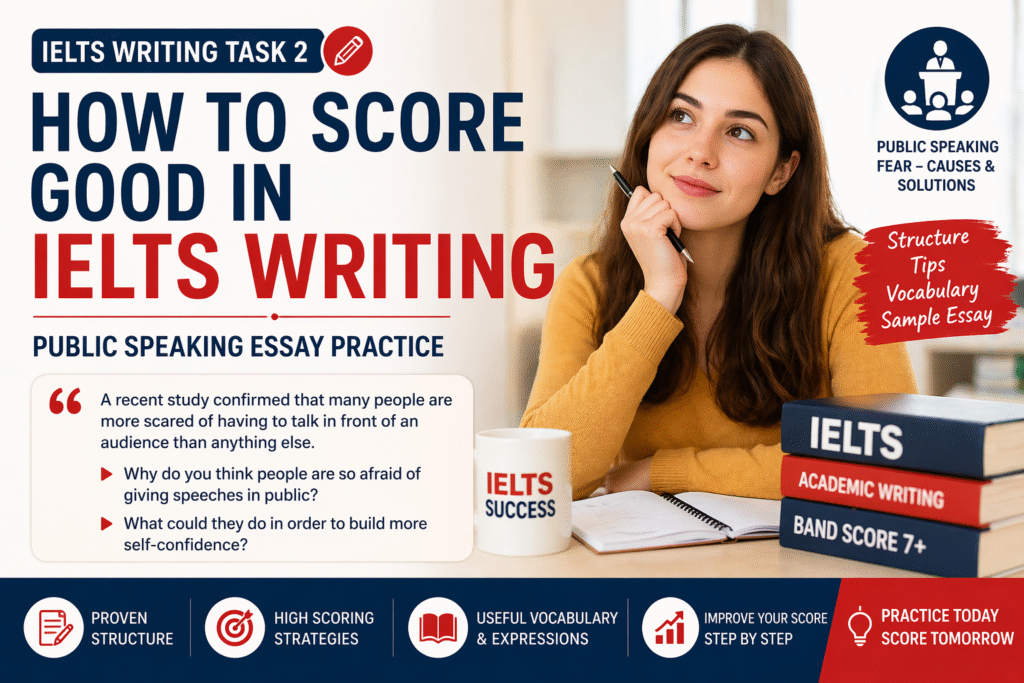
How to Score Good in the IELTS Writing Exam: Public Speaking Essay Practice
Improve your IELTS Writing Task 2 performance with a real practice essay, strong structure, useful vocabulary, and expert tips. In this guide, we break down a common topic about fear of public speaking and show you how to write a high-scoring response.
Two-Part Question Essay
Understand the reasons behind public speaking fear and explain practical ways to build self-confidence in a clear, well-developed IELTS essay.
IELTS Writing Task 2 Topic
Write about the following topic:
A recent study confirmed that many people are more scared of having to talk in front of an audience than anything else.
Why do you think people are so afraid of giving speeches in public?
What could they do in order to build more self-confidence?
What type of essay is this?
This is a two-part question essay. You must answer both parts of the question equally:
- why people are afraid of public speaking,
- how they can build self-confidence.
What the examiner expects
- a clear answer to both questions,
- well-organized paragraphs,
- fully developed ideas,
- accurate grammar and vocabulary.
Best Structure for a High-Scoring IELTS Essay
Introduction
Paraphrase the question and state your main opinion clearly.
Body Paragraph 1
Explain why people are afraid of public speaking. Develop one or two strong reasons.
Body Paragraph 2
Suggest practical solutions to build confidence and explain how they help.
Conclusion
Summarize your answer in a short and clear final paragraph.
Band-Style IELTS Essay Example
Any type of performance in front of an audience is a source of anxiety and insecurity for many people. Even the most extroverted and sociable individuals may become nervous if they are required to speak in front of a large group of people, especially strangers.
One of the main reasons for this fear is insecurity about personal ability. Most people are aware of their weaknesses and know that audiences often form opinions quickly. As a result, speakers tend to focus less on the content of their speech and more on how they are being judged. This fear of negative evaluation can make them lose concentration, forget their words, or become visibly anxious.
Another important reason is lack of experience. Public speaking is a skill, and people who rarely practice it are more likely to feel overwhelmed. Since they are unfamiliar with managing an audience, controlling their voice, or handling mistakes, the situation feels highly stressful.
In my opinion, the best way to build self-confidence is through preparation and gradual exposure. People can begin by rehearsing their speech in front of a mirror and then in front of a small group of trusted friends. This helps them become more comfortable and identify areas for improvement. Visualization can also be effective, as imagining a successful performance helps create a more positive mindset. In addition, speakers should accept that perfection is unrealistic. Small mistakes are normal, and focusing too much on them only increases pressure.
In conclusion, people are often afraid of public speaking because they fear judgment and lack practice. However, with preparation, repetition, and a realistic attitude toward mistakes, they can gradually become much more confident speakers.
Why This Essay Works
Answers Both Questions
The essay explains the causes of fear and also gives clear solutions, which is essential for this task type.
Logical Development
Each paragraph has one main focus, making the essay easy to follow and well organized.
Formal Academic Tone
The language is natural, formal, and suitable for IELTS Writing Task 2.
Relevant Vocabulary
The essay uses useful topic vocabulary such as anxiety, judgment, self-confidence, and gradual exposure.
How to Score Higher in IELTS Writing Task 2
Identify the essay type first
Always check whether the task is an opinion essay, discussion essay, or two-part question essay before planning.
Plan your ideas for 3 to 5 minutes
A short plan helps you organize your response and avoid repeating the same point later.
Develop your ideas fully
Do not only state a reason. Explain it and show why it matters with a simple example or effect.
Use linking words carefully
Use connectors such as one of the main reasons, as a result, another factor, and in conclusion.
Keep your language clear
You do not need very complicated words. Clear ideas and accurate grammar are more important than difficult vocabulary.
Words and Phrases for This Topic
Fear and anxiety
performance anxiety
fear of judgment
feel under pressure
Reasons
one of the main reasons is
another important factor is
as a result
Solutions
build self-confidence
gradual exposure
positive mindset
Conclusion
in conclusion
can gradually improve
become more confident
Common IELTS Writing Mistakes
- answering only one part of the question,
- writing ideas without explanation,
- using memorized phrases unnaturally,
- repeating the same vocabulary too often,
- writing an unclear or weak conclusion.
How to Practice IELTS Writing More Effectively
The best way to improve your IELTS writing score is to practice with real questions, review model answers, and learn how ideas are developed. Focus on writing clear paragraphs, supporting each point properly, and checking your work for grammar and vocabulary errors.
Over time, regular essay practice will help you write faster, think more clearly, and feel much more confident on exam day.
Master IELTS Writing with Better Structure and Stronger Ideas
Build your writing confidence with guided practice, sample essays, topic vocabulary, and smart strategies that help you score higher in IELTS Writing Task 2.
Start Practicing Today