
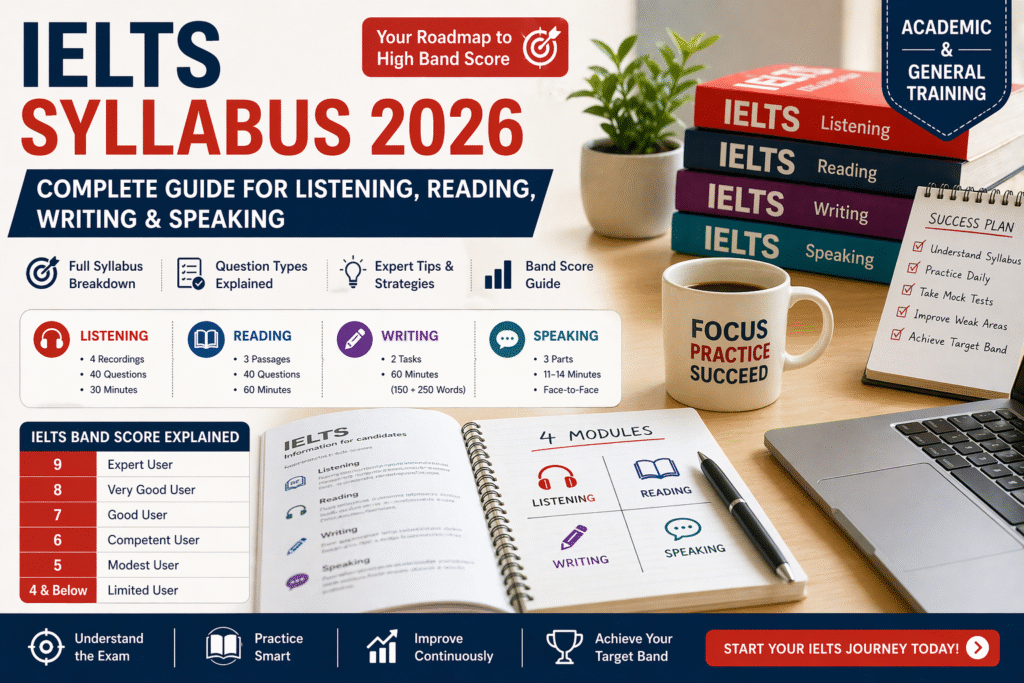
IELTS Syllabus 2026: Complete Guide for Listening, Reading, Writing & Speaking
Understand the full IELTS syllabus with a clear breakdown of all four modules, question types, band score system, and smart preparation strategies to help you score higher in the exam.
All 4 IELTS Modules
Get a detailed understanding of Listening, Reading, Writing, and Speaking, along with exam format, timing, and scoring.
What is IELTS?
The International English Language Testing System (IELTS) is one of the most widely accepted English proficiency exams for students, professionals, and immigrants. It evaluates your ability to use English effectively in academic, professional, and everyday situations.
IELTS Academic
Designed for students applying to universities or higher education programs where English is the language of instruction.
IELTS General Training
Suitable for migration, work, and general life situations in English-speaking countries.
IELTS Exam Pattern at a Glance
| Section | Duration | Description |
|---|---|---|
| Listening | 30 minutes | 4 recordings, 40 questions |
| Reading | 60 minutes | 3 passages, 40 questions |
| Writing | 60 minutes | 2 tasks |
| Speaking | 11–14 minutes | Face-to-face interview |
IELTS Listening Syllabus
The Listening section is the same for both Academic and General Training. You will hear four recordings and answer 40 questions.
Part 1
Conversation in a social context
Part 2
Monologue such as a speech or announcement
Part 3
Academic discussion between multiple speakers
Part 4
Lecture or academic talk
Skills Tested
- understanding main ideas,
- identifying specific details,
- following conversations,
- recognizing opinions and attitudes.
Common Question Types
- multiple choice,
- matching,
- form completion,
- sentence completion,
- map labeling.
IELTS Reading Syllabus
The Reading section differs slightly between Academic and General Training.
Academic Reading
Includes 3 long passages taken from books, journals, magazines, or research-based texts.
General Reading
Includes everyday texts such as notices, advertisements, workplace instructions, and short passages.
Skills Tested
Skimming, scanning, understanding arguments, identifying writer’s opinion, and locating specific information.
Question Types
True/False/Not Given, matching headings, sentence completion, and multiple choice questions.
Preparation Tip
Do not read every word. Learn to scan for keywords and manage your time across all 3 passages.
IELTS Writing Syllabus
The Writing section is often considered one of the most challenging parts of the IELTS exam. It tests your ability to organize ideas, use grammar correctly, and write coherently.
Academic Writing
Task 1: Describe a graph, chart, table, map, or process (150 words minimum).
Task 2: Write an essay such as opinion, discussion, or problem-solution essay (250 words minimum).
General Writing
Task 1: Write a formal, semi-formal, or informal letter.
Task 2: Write an essay similar to Academic Task 2.
Task Achievement
Answer the question fully and clearly.
Coherence & Cohesion
Organize paragraphs logically and use linking words naturally.
Vocabulary
Use relevant and accurate words for the topic.
Grammar
Show control over sentence structure and grammar accuracy.
IELTS Speaking Syllabus
The Speaking test is a face-to-face conversation with an examiner and is divided into 3 parts.
Introduction & Interview
Questions about yourself, your home, studies, hobbies, work, and daily life.
Cue Card
You receive a topic and speak for 1 to 2 minutes after a short preparation time.
Discussion
A deeper conversation related to the Part 2 topic, where you express opinions and ideas in detail.
Skills Tested
Fluency, pronunciation, vocabulary range, grammar accuracy, and ability to develop ideas naturally.
Preparation Tip
Practice speaking every day, record yourself, and focus on natural communication instead of memorized answers.
IELTS Band Score Explained
IELTS is scored on a scale from Band 0 to Band 9. Your overall band score is the average of your Listening, Reading, Writing, and Speaking scores.
| Band | Level |
|---|---|
| 9 | Expert User |
| 8 | Very Good User |
| 7 | Good User |
| 6 | Competent User |
| 5 | Modest User |
How to Prepare for IELTS Effectively
Understand the exam format
Before starting practice, know what each section tests and how much time you have.
Practice regularly
Consistency is more important than studying for long hours only occasionally.
Focus on weak areas
Identify which skill is your weakest and spend extra time improving it.
Use real IELTS questions
Practice with exam-style materials so you become familiar with the format and difficulty level.
Build topic vocabulary
Learn words and phrases related to education, technology, environment, health, and society.
Common IELTS Preparation Mistakes
- ignoring time management,
- memorizing essays and speaking answers,
- not practicing all four skills equally,
- focusing only on grammar without improving ideas,
- avoiding mock tests before the real exam.
Conclusion
The IELTS syllabus becomes much easier to manage when you understand its structure clearly. Each module is designed to test real-life English communication, so your preparation should focus on accuracy, clarity, and regular practice.
With a strong study plan, smart strategy, and consistent revision, you can improve your performance and move closer to your target band score.
Master the IELTS Syllabus with Smart Preparation
Build confidence in Listening, Reading, Writing, and Speaking with structured practice, expert strategies, and a clear understanding of the exam format.
Start Your IELTS Preparation