
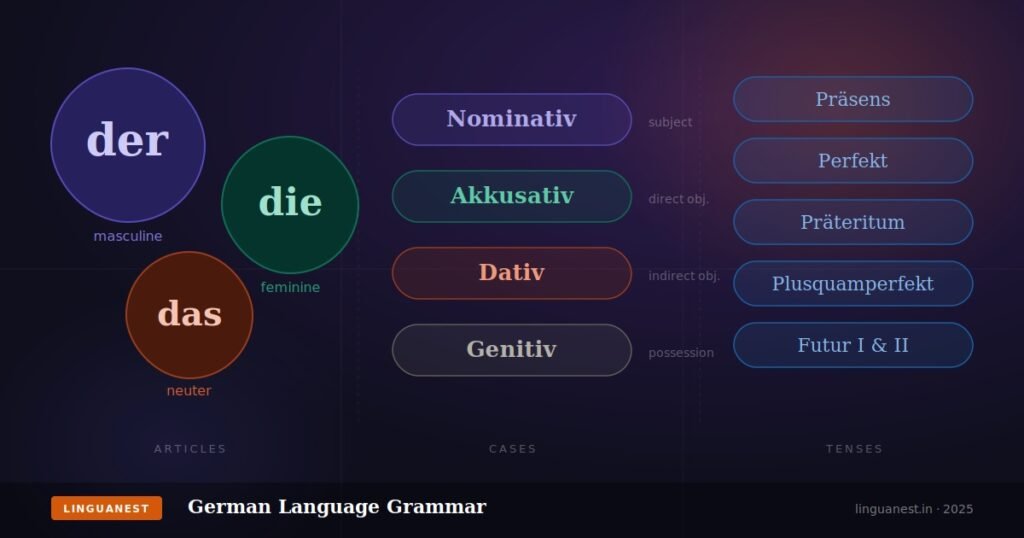
German Language Grammar: A Complete Beginner’s Guide (2025)

Grammar is the skeleton of any language — and German grammar has a reputation for being particularly demanding. But that reputation is often overstated. Once you understand the system behind German’s tenses, cases, and articles, the language becomes remarkably logical. Whether you’re preparing for a A1 German course or pushing toward B2, this guide walks you through every essential concept.
Why German Grammar Feels Hard (But Isn’t)
German belongs to the West Germanic language family — the same branch as English. A surprising amount of vocabulary already overlaps: Haus (house), Wasser (water), Musik (music). What trips learners up isn’t the words; it’s the inflection system — the way articles and adjectives change endings based on a noun’s role in the sentence.
The good news: German is highly rule-governed. Once you grasp the patterns, correct sentences follow automatically. According to the Foreign Service Institute (FSI), German takes roughly 750 classroom hours for English speakers to reach professional proficiency — making it one of the more accessible European languages for structured learners.
Indian learner advantage: Speakers of Hindi, Tamil, Kannada, or Bengali already understand grammatical gender and case endings. This gives you a genuine head-start over native English speakers. Explore how we leverage this in our A1 German course.
The 6 German Tenses Explained
German has six tenses. Here is a clear breakdown with example sentences so you can see each one in action immediately:
“I am learning German.”
“I learned German.”
“I have learned German.”
“I had learned German.”
“I will learn German.”
“I will have learned.”
Which Tense Should Beginners Learn First?
Prioritise Präsens and Perfekt. In everyday spoken German, Perfekt is used far more often than Präteritum — which is mainly found in written or literary contexts. Once these two are solid, add Futur I. This is exactly the progression followed in our A1 and A2 courses.

The 4 Cases: Nominative, Accusative, Dative, Genitive
German uses four grammatical cases to show the role a noun plays in a sentence. The case determines the form of the article. This is comparable to Hindi’s karak (कारक) system or Tamil’s வேற்றுமை, making it intuitive for Indian learners.
“The man reads.”
“I see the man.”
“I give the man a book.”
“The man’s book.”
Definite Article Endings by Case
| Case | Masculine | Feminine | Neuter | Plural |
|---|---|---|---|---|
| Nominativ | der | die | das | die |
| Akkusativ | den | die | das | die |
| Dativ | dem | der | dem | den |
| Genitiv | des | der | des | der |
For a deeper dive into case usage with prepositions, the Deutsche Welle’s free German course is an excellent free supplement.
Der, Die, Das — Mastering German Articles
Every German noun has a grammatical gender: masculine (der), feminine (die), or neuter (das). Crucially, grammatical gender doesn’t always match biological gender — das Mädchen (the girl) is neuter.
The golden rule: always learn a new noun with its article. Don’t just write Tisch — write der Tisch. This single habit prevents the most common errors at every level from A1 to C1.
Patterns That Reveal a Noun’s Gender
| Ending / Pattern | Gender | Examples |
|---|---|---|
| -ung | Feminine (die) | die Zeitung, die Wohnung |
| -heit / -keit | Feminine (die) | die Freiheit, die Möglichkeit |
| -schaft | Feminine (die) | die Freundschaft, die Mannschaft |
| -er (agent nouns) | Masculine (der) | der Lehrer, der Fahrer |
| Days, months, seasons | Masculine (der) | der Montag, der Januar, der Sommer |
| -chen / -lein (diminutives) | Neuter (das) | das Mädchen, das Büchlein |
| Gerunds (verbal nouns) | Neuter (das) | das Lernen, das Essen |
🎓 CEFR Levels & What Grammar You Need
The Goethe-Institut’s official exams follow the CEFR framework. Here’s the grammar scope at each level:
- A1–A2: Basic articles, Präsens, Perfekt, simple phrases — Start here
- B1–B2: All four cases, Konjunktiv II, passive voice, complex sentences — B1 course
- C1–C2: Subjunctive mood, idiomatic usage, academic writing — C1 course
German Sentence Structure & Word Order
German word order is one of the most distinctive features of the language. The key rule: the conjugated verb always occupies the second position in a main clause (the “V2 rule”).
The Verb-Second (V2) Rule
No matter what element starts a German sentence, the verb comes second:
| Position 1 | Position 2 (Verb) | Rest |
|---|---|---|
| Ich | lerne | heute Deutsch. |
| Heute | lerne | ich Deutsch. |
| Deutsch | lerne | ich heute. |
All three mean “I am learning German today” — emphasis shifts with position 1.
Subordinate Clauses: Verb Goes to the End
In subordinate clauses (introduced by weil, dass, obwohl, wenn), the verb moves to the very end of the clause. This is called Verbendstellung:
Main clause: Ich lerne Deutsch.
With subordinate clause: Ich lerne Deutsch, weil es sehr interessant ist.
“I am learning German because it is very interesting.”

Essential German Phrases for Daily Life
The fastest way to make grammar feel real is to attach it to phrases you actually use. Learning these expressions also helps you spot tenses and articles in the wild. For more vocabulary, check out our beginner German vocabulary guide.
Greetings & Introductions
Politeness & Everyday Communication
Celebrations
Top Tips to Learn German Grammar Fast
Always Learn Nouns with Their Articles
Never write just Tisch in your vocabulary notebook. Always write der Tisch. This habit alone prevents hundreds of future errors. Our A1 course builds this from your very first lesson.
Use Spaced Repetition for Cases & Articles
Tools like Anki and Leo.org let you drill gender and case endings using spaced repetition — the most evidence-backed memorisation method. Just 10–15 minutes daily compounds quickly.
Speak from Day One
German native speakers are patient with learners. Making mistakes is the fastest feedback loop. Activate Perfekt early — it covers 90% of past-tense conversations. Find a speaking partner via Tandem or join our live online sessions at LinguaNest.
Consume German Media
Watch German with German subtitles. Deutsche Welle’s free courses are structured by CEFR level. The Netflix series Dark is excellent for B1+ learners who want authentic dialogue and natural speech rhythm.
Aim for a Goethe-Institut Exam
If you’re learning German for work, study, or migration, structure your study around the official Goethe-Institut exams. Read our complete Goethe exam guide and see how LinguaNest prepares you for every level.
2025 Update: Germany remains the top destination for Indian students under the APS certificate procedure. A B2/C1 German level is increasingly required for public university admission. If studying in Germany is your goal, read our guide on studying in Germany as an Indian student and start your grammar foundation today.
Ready to Start Speaking German?
Join LinguaNest’s structured German courses — A1 to C2 — designed for Indian learners with expert instructors and Goethe exam preparation.
Start with A1 → View All Courses