
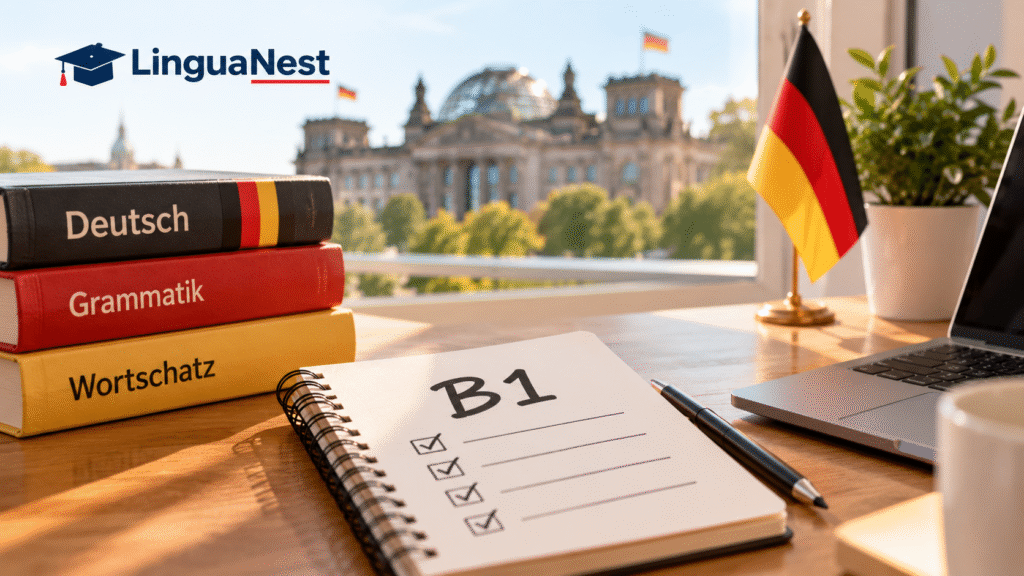
German B1 Checklist: Everything You Need to Reach the Independent User Level
✍️ By Lingua Nest Editorial Team | 📅 Last updated: September 2026 | ⏱ 9 min read
Photo: Kelly Brito / Unsplash

If A1 was about surviving your first conversation, B1 is where German actually starts working for you. It’s the level the CEFR calls the “independent user” milestone — the point where you can hold a real conversation, follow the gist of a work meeting, and handle an unexpected situation without switching back to English. It’s also, not coincidentally, the level most nursing placements, Ausbildung programmes, and visa categories treat as the real starting line.
This checklist covers exactly what B1 requires — grammar, vocabulary, speaking, and exam format — building directly on the basics. If you’re starting from zero, our German A1 checklist is the natural place to begin first.
German B1 Checklist at a Glance
| Skill Area | What B1 Requires | Priority |
|---|---|---|
| Grammar | Perfekt, Präteritum & Konjunktiv II mastery | Must-Know |
| Grammar | Subordinate clauses (weil, dass, obwohl, wenn) | Must-Know |
| Vocabulary | Approx. 2,400-word working vocabulary | Must-Know |
| Speaking | Hold a conversation on familiar topics unprompted | Must-Know |
| Listening | Follow the gist of a meeting, podcast, or news segment | Good-to-Know |
| Exam Format | Reading, listening, writing & speaking (Goethe or TELC) | Must-Know |
What Does B1 Actually Mean?
B1 is the third of six CEFR levels, and it marks the shift from “beginner” to “independent user.” Practically, that means you can understand the main points of straightforward input on familiar matters, deal with most situations likely to arise while travelling, produce simple connected text, and describe experiences, events, and ambitions while briefly explaining your reasoning.
The Complete German B1 Checklist
Grammar Checklist
B1 grammar builds directly on your A1–A2 foundation, adding the structures that let you talk about the past, express polite hypotheticals, and connect ideas into longer sentences:
- Perfekt (conversational past) — with both haben and sein
- Präteritum (narrative past) — especially for sein, haben, modal verbs, and common verbs like gehen and kommen
- Plusquamperfekt (past perfect) — for describing what had already happened
- Konjunktiv II — for polite requests, wishes, and hypotheticals (Ich würde gern…, Wenn ich Zeit hätte…)
- Futur I — for stating plans and predictions
- Subordinate clauses with weil, dass, ob, wenn, als, obwohl, damit, bevor, and nachdem
- All four cases used correctly inside longer, more complex sentences
Our complete German grammar guide covers each of these structures in more depth, with the A1–A2 basics they build on.
Vocabulary Checklist
Where A1 vocabulary covers survival basics, B1 vocabulary needs to stretch across roughly 2,400 words, spanning:
- Work, study, and career-related vocabulary
- Opinions, plans, hopes, and personal ambitions
- Media, news, and current-affairs vocabulary at a basic level
- Health, environment, and everyday social topics
- Giving reasons and explanations, not just facts
Speaking & Listening Checklist
Photo: Christina @ wocintechchat.com / Unsplash

This is where B1 genuinely differs from earlier levels — it’s tested through real, unscripted communication rather than memorised phrases. By the end of B1, you should be able to:
- Hold a conversation on familiar topics without switching to English mid-sentence
- Follow the main points of a work meeting, a podcast, or a friend explaining their weekend
- Express and briefly justify opinions and plans
- Handle an unexpected situation — a change of plan, a misunderstanding — without freezing up
Exam Format Checklist
Most learners take either the Goethe-Zertifikat B1 or the telc B1 exam — both testing the same four skills, structured slightly differently:
| Section | What It Tests |
|---|---|
| Reading | Everyday texts, notices, short articles |
| Listening | Conversations, announcements, short broadcasts |
| Writing | A structured personal or semi-formal text |
| Speaking | A structured conversation, often including a paired or examiner-led task |
Some providers also offer a dual A2/B1 exam, where your final certificate level depends on your score. For a full breakdown of the telc format specifically, see our TELC German exam preparation guide. Official Goethe-Zertifikat B1 exam details are available directly from the Goethe-Institut.
How Long Does It Take to Reach B1?
Building on a solid A2 foundation, most learners need roughly 350–650 cumulative hours of structured study from zero to reach a comfortable B1 — with meaningful variation depending on prior language background and how consistently you practise speaking, not just grammar drills.
Why B1 Matters for Nursing, Ausbildung & Visa Routes
B1 isn’t just an academic milestone. German nursing employers typically expect B1 as a minimum before placement, most Ausbildung candidates are placed at B1–B2, and several visa categories treat B1 as the effective baseline for independent life in Germany. If you’re specifically on the nursing pathway, our Nursing Ausbildung A1 to placement guide shows exactly how this checklist fits into that bigger journey.
Common Mistakes at B1 Level
- Over-relying on Perfekt and ignoring Präteritum — both matter, and narrative Präteritum shows up constantly in written German.
- Treating Konjunktiv II as optional — it’s essential for sounding polite and natural, not just for advanced grammar points.
- Avoiding subordinate clauses — sticking to short main clauses caps your fluency well below what B1 actually requires.
- Under-practising listening — reading comprehension improves faster than listening for most learners, so it needs deliberate extra attention.
- Memorising vocabulary without using it in full sentences — isolated word lists rarely translate into real speaking ability.
Frequently Asked Questions
Is German B1 hard to reach from A2?
It’s a genuine step up — B1 introduces several new tenses and subordinate clause structures at once — but it’s very achievable with consistent practice, particularly if speaking is prioritised alongside grammar.
How many words do I need to know for B1?
Around 2,400 words is the commonly cited benchmark for Goethe-Zertifikat B1, covering everyday, work, and opinion-based vocabulary.
Is Goethe B1 or TELC B1 better for visa or job purposes?
Both are widely accepted by German authorities and employers. The better choice usually comes down to which exam format and test centre suit you, rather than one being more broadly recognised than the other.
Do I need B1 for a nursing Ausbildung in Germany?
Yes — B1 is the commonly required minimum for most nursing Ausbildung placements, with many employers preferring B2. See our Nursing Ausbildung guide for the full pathway.
Ready to reach B1 with structured, exam-focused guidance? LinguaNest’s German language course takes you from A1 through B1, B2, and beyond, with dedicated speaking practice and mock exams built in at every level — both online and offline.