
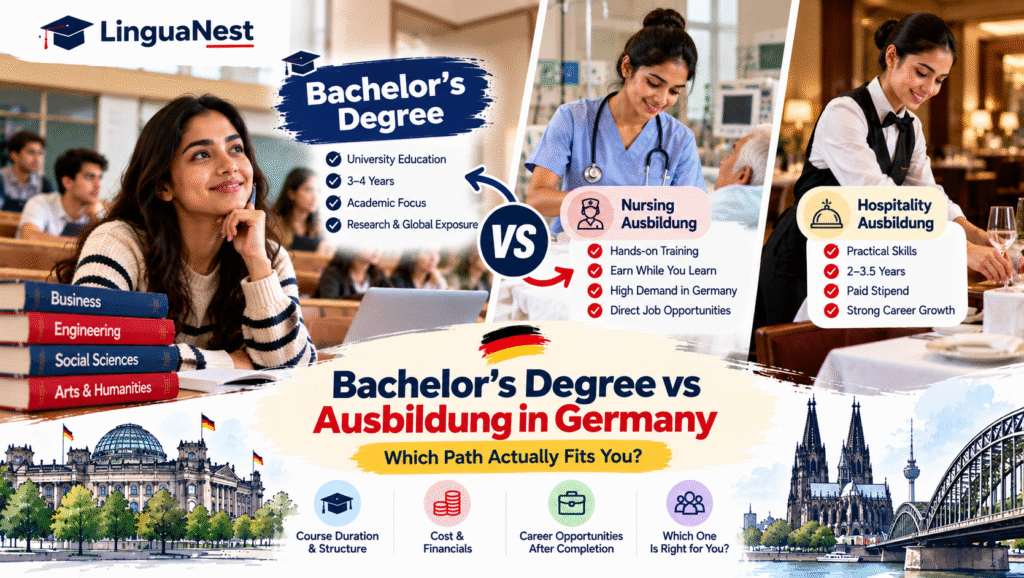
Bachelor’s Degree vs Ausbildung in Germany: Which Path Actually Fits You?
✍️ By Lingua Nest Editorial Team | 📅 Last updated: September 2026 | ⏱ 9 min read
Photo: Vitaly Gariev / Unsplash

In India, the path after 12th grade is mostly one road: pick a stream, get into a college, earn a degree. Germany hands you a genuine fork instead — a Bachelor’s degree at a university, or Ausbildung, a paid vocational training programme that leads straight into skilled employment. Neither one is the “lesser” option, and treating this like an obvious choice is exactly how students end up on the wrong path for their goals.
Here’s a straightforward, side-by-side look at both routes — so you can decide based on what actually fits you, not just which option sounds more familiar.
Bachelor’s Degree vs Ausbildung at a Glance
| Factor | Bachelor’s Degree | Ausbildung |
|---|---|---|
| Duration | 3 years (plus 1 extra Studienkolleg year for most Indian students) | 2–3.5 years, average around 3 |
| Income During Training | None — living costs must be self-funded (blocked account required) | Paid monthly stipend from day one |
| German Language Needed | Often minimal for English-taught programmes | B1–B2 typically required from the start |
| Qualification Type | Academic degree — required for research, further postgraduate study | Industry-recognised vocational certificate (IHK/HWK) |
| Path to Residency | Both lead to valid long-term residency routes in Germany | |
What Does the Bachelor’s Degree Path Actually Involve?
German public universities are largely tuition-free, which is the single biggest draw for international students. But there’s a structural detail that catches many Indian students off guard: German university admission generally assumes 13 years of schooling, while the Indian system runs 12. That extra year is usually made up through a Studienkolleg — a preparatory year that ends in an assessment test before you can formally enrol, unless your intended course and marks qualify you for direct admission.
Once enrolled, the structure is theory-heavy: lectures, seminars, and independent research, typically over three years for a Bachelor’s, with an optional two-year Master’s after. Since there’s no income during study, a blocked account demonstrating sufficient funds is a standard visa requirement.
What Does Ausbildung Actually Involve?
Photo: Mathurin NAPOLY / Unsplash

Ausbildung is Germany’s dual education system — training split between hands-on work at a company and theory classes at a vocational school (Berufsschule). You’re employed and paid from your very first day, with no tuition fees at all. On completion, you receive an industry-recognised vocational certificate through the IHK (Industrie- und Handelskammer) or HWK (Handwerkskammer), depending on your trade.
The trade-off is that Ausbildung requires functional German from the start — typically B1, sometimes B2 depending on the field — since both classroom instruction and workplace communication happen in German. For a full breakdown of who qualifies and what it pays, see our Ausbildung eligibility and salary guide.
Which Path Actually Fits You?
| Your Situation | Better Fit |
|---|---|
| Want financial independence from day one, not later | Ausbildung |
| Aiming for research, a specialised academic field, or an eventual PhD | Bachelor’s Degree |
| Prefer hands-on, practical learning over classroom theory | Ausbildung |
| Have strong English but limited German, and want to start soon | Bachelor’s Degree (English-taught programme) |
| Targeting a shortage field like nursing or skilled trades | Ausbildung |
| Family can support 3–5 years of costs with no income | Bachelor’s Degree |
The Myth Worth Correcting: “Ausbildung Is Lesser Than a Degree”
Academically, the two aren’t equivalent — a Bachelor’s is a university qualification, and Ausbildung is a vocational one. But in Germany’s job market, that distinction doesn’t translate into Ausbildung being a lesser choice. Skilled trades and vocational roles are well-compensated and, in fields facing genuine shortages, in higher demand than some general degree fields. German employers generally see a qualified Ausbildung graduate as job-ready from day one, which carries real weight in hiring decisions.
If you’re specifically looking at a shortage field, our Nursing Ausbildung guide shows exactly how this plays out in practice — a vocational path leading to a state-recognised qualification and long-term residency, without a university degree involved at all.
Can You Switch Paths Later?
Yes — and this flexibility surprises a lot of students. Ausbildung graduates aren’t locked out of higher education: with additional qualifications such as a Meister (master craftsman) certificate, or by meeting specific university entry criteria, moving into a degree programme later is genuinely possible. Germany also offers dual study programmes (duales Studium), which blend a university degree with paid company work — a genuine middle ground worth knowing about if you can’t decide between the two.
Frequently Asked Questions
Do I need German to start a Bachelor’s degree in Germany?
Not always — many English-taught programmes, especially at Master’s level, require little to no German initially. That said, a Studienkolleg year and daily life in Germany are considerably smoother with at least basic German.
Is Ausbildung recognised outside Germany?
Recognition varies by country and profession, since Ausbildung is a German-specific vocational system. Within Germany and the broader EU, however, it’s a well-respected, industry-standard qualification.
Which option is faster to complete?
Ausbildung is generally the faster route to paid, skilled employment — typically 2 to 3.5 years, compared with 3 years for a Bachelor’s alone (often 4, once a Studienkolleg year is included for Indian students).
Can I do a Master’s after completing Ausbildung?
Not directly in most cases — a Bachelor’s degree is usually the standard entry requirement for a Master’s programme. However, further vocational qualifications like a Meister can open alternate routes into higher education.
For official details on studying in Germany, visit DAAD, the German Academic Exchange Service, and for Ausbildung and skilled-worker pathways, see Make it in Germany, the official government portal for professionals.
Whichever path you choose, German proficiency makes it work better. LinguaNest’s structured German language course takes you from A1 through B2 and beyond — whether you’re prepping for Ausbildung, a Studienkolleg year, or simply daily life in Germany.