
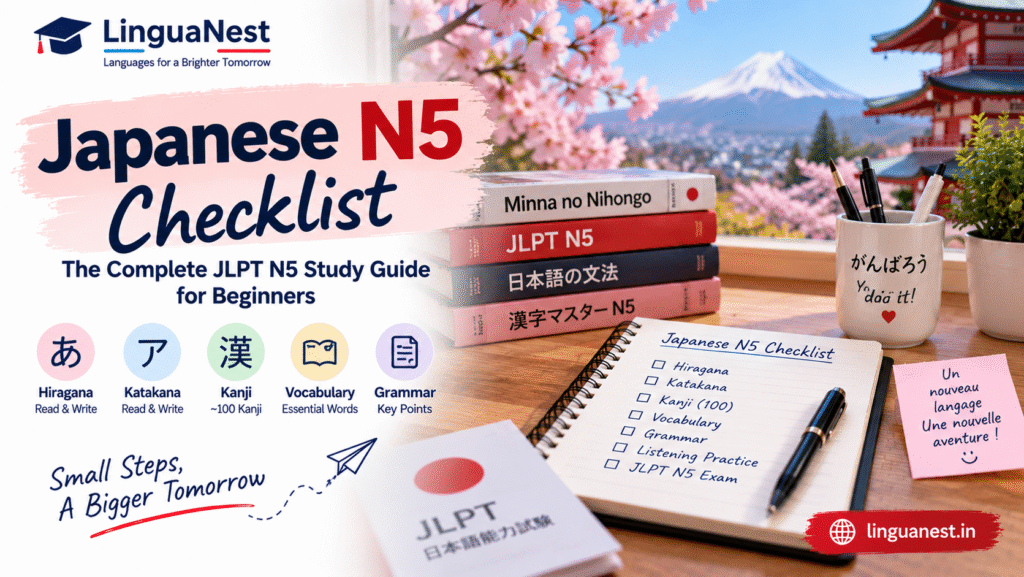
Japanese N5 Checklist: The Complete JLPT N5 Study Guide for Beginners
✍️ By Lingua Nest Editorial Team | 📅 Last updated: September 2026 | ⏱ 9 min read
Photo: Kelly Brito / Unsplash

If Japanese is completely new to you — whether you’re starting for anime and culture, planning a move to Japan, or working toward the Specified Skilled Worker (SSW) visa — JLPT N5 is where the journey officially begins. But unlike more familiar language exams, N5 comes with its own learning curve: two entirely new phonetic scripts, around 100 kanji, and an exam format that’s nothing like a typical school test.
This Japanese N5 checklist breaks the level down into exactly what you need to cover — scripts, vocabulary, grammar, listening, and the real exam structure — so you know precisely where you stand before test day.
Japanese N5 Checklist at a Glance
Here is every topic on this Japanese N5 checklist in one place — save this table and tick each row off as you go.
| Skill Area | Topic to Master | Priority |
|---|---|---|
| Writing System | Hiragana — all 46 characters, read & write | ● Must-Know |
| Writing System | Katakana — all 46 characters, read & write | ● Must-Know |
| Writing System | Roughly 100 core Kanji (numbers, days, basic verbs, places) | ● Must-Know |
| Vocabulary | Core 800-word N5 vocabulary list | ● Must-Know |
| Vocabulary | Numbers, dates, time expressions & counters | ● Good-to-Know |
| Grammar | Basic particles — は, が, を, に, で | ● Must-Know |
| Grammar | Present & past tense (ます-form) verb conjugation | ● Must-Know |
| Grammar | Adjective types — i-adjectives & na-adjectives | ● Good-to-Know |
| Grammar | Simple question forms & negation | ● Good-to-Know |
| Reading | Short passages — signs, emails, simple notices | ● Must-Know |
| Listening | Short, slow everyday conversations & announcements | ● Good-to-Know |
| Exam Format | Vocabulary, Grammar+Reading & Listening sections (90 min total) | ● Must-Know |
What Is JLPT N5, Exactly?
The Japanese-Language Proficiency Test (JLPT) is the world’s largest standardised test for non-native Japanese speakers, jointly administered by the Japan Foundation and Japan Educational Exchanges and Services. It runs across five levels — N5 (entry level) through N1 (near-native) — and is held twice a year, typically on the first Sunday of July and December, at test centres worldwide.
N5 confirms that you can understand basic Japanese used in everyday situations: simple greetings, short written passages, and slow, clearly spoken conversation. It is entirely multiple choice, with no speaking or writing section — every question tests reading, listening, vocabulary, or grammar recognition.
You can find the full official breakdown of sections and timing on the JLPT’s official test structure page.
Who Actually Needs a JLPT N5 Certificate?
N5 isn’t just a symbolic first step — for many learners, it has a real, practical purpose. You’ll likely want a documented N5 level if you are:
- A complete beginner building a structured foundation before progressing to N4 and beyond.
- Working toward Japan’s Specified Skilled Worker (SSW) visa, where basic Japanese ability is often an early milestone.
- Applying to a Japanese language school as a first step toward higher education in Japan.
- Targeting a career that touches Japan — trade, tourism, IT outsourcing, or manufacturing — where any documented Japanese ability strengthens your profile.
- Using N5 as a personal milestone before deciding whether to commit to the full JLPT ladder.
If your goal is eventually reaching a job-ready level, our guide on JLPT N5 vs N4 — which level to start with explains exactly where the two levels differ and why N5 is usually the right starting point.
The Complete Japanese N5 Checklist
Photo: Niketh Vellanki / Unsplash

1. Writing System Checklist
Unlike most European languages, Japanese starts with mastering three separate writing systems before grammar even comes into play:
- Hiragana — the core phonetic script (46 characters) used for native Japanese words and grammar endings.
- Katakana — the second phonetic script (46 characters), mainly used for foreign loanwords and names.
- Roughly 100 Kanji — the most frequently used characters covering numbers, days, basic verbs, and everyday places.
For a structured walkthrough of exactly which kanji to prioritise, see our complete guide to understanding Japanese kanji.
2. Vocabulary Checklist
N5 vocabulary revolves around roughly 800 words for daily-life essentials. Make sure you’re comfortable with:
- Greetings and self-introduction phrases
- Numbers, dates, days of the week, and telling time
- Family members and everyday relationships
- Food, shopping, and simple transactions
- Places, directions, and transport
- Common adjectives and basic adverbs
3. Grammar Checklist
By the end of N5, you should be comfortable with:
- Basic particles — は (topic), が (subject), を (object), に and で (location/time).
- ます-form verb conjugation for present and past tense, both affirmative and negative.
- い-adjectives and な-adjectives, and how each changes for past tense and negation.
- Simple question formation using か, and basic negation patterns.
- Counters for people, objects, and time — one of the trickier concepts for English speakers.
- Basic connectors such as と (and) and て-form for simple sequencing.
Our guide to Japanese adjectives and conjugation is a useful companion for this section specifically.
4. Reading & Listening Checklist
- Reading short notices, signs, and simple emails written mostly in hiragana, katakana, and basic kanji.
- Understanding short dialogues between two speakers in everyday settings (classroom, shop, station).
- Picking out key information — time, place, quantity — from slow, clearly spoken audio.
5. Exam Format Checklist
The JLPT N5 exam has three sections, all multiple choice, totalling 90 minutes:
| Section | What It Tests | Duration |
|---|---|---|
| Language Knowledge (Vocabulary) | Kanji readings, word choice, word usage | 20 minutes |
| Language Knowledge (Grammar) & Reading | Grammar patterns, sentence structure, short passages | 40 minutes |
| Listening | Short conversations and announcements | 30 minutes |
To pass, you need a total score of at least 80 out of 180 — but total score alone isn’t enough. There are also minimum thresholds for each section, so a strong vocabulary score can’t compensate for a weak listening score. Full scoring details are available on the official JLPT test sections page.
How Long Does It Take to Reach JLPT N5?
Most complete beginners need somewhere between 250 and 450 hours of structured study to comfortably reach N5, depending on prior exposure to kanji-based languages and study consistency. With focused daily practice, that typically translates to a realistic 3–6 month timeline. If you’re working with a tighter deadline, our guide on passing JLPT in 3 months lays out exactly how to structure that sprint.
Common Mistakes Beginners Make at N5 Level
- Skipping Hiragana and Katakana mastery — relying on romaji (Roman letters) early on slows every stage that follows.
- Treating Kanji as optional — even at N5, around 100 kanji appear directly in the exam.
- Memorising vocabulary in isolation — words stick far better inside full example sentences.
- Ignoring listening practice — many learners over-focus on reading and under-prepare for the audio section, which has its own minimum passing score.
- Underestimating counters — Japanese counting words are genuinely unfamiliar to English and Hindi speakers and need dedicated practice.
Free Resources to Practice Japanese N5
Frequently Asked Questions
Is JLPT N5 hard for absolute beginners?
N5 is specifically designed as the entry level, so it doesn’t assume any prior Japanese knowledge. The main challenge isn’t difficulty — it’s volume: two new scripts and around 100 kanji in a completely unfamiliar writing system.
How many hours does it take to reach Japanese N5?
Most learners need roughly 250–450 hours of structured study, translating to about 3–6 months with consistent daily practice.
Do I need to learn Kanji for N5, or just Hiragana and Katakana?
You need all three. While Hiragana and Katakana form the foundation, the JLPT N5 exam does test around 100 core kanji directly, so skipping them isn’t an option if you’re aiming to pass the official test.
Can I prepare for JLPT N5 online from India?
Yes. Structured live online classes with a qualified trainer, regular mock tests, and dedicated listening practice can take a complete beginner from zero to exam-ready N5 in a few months.
Ready to start your Japanese N5 journey? LinguaNest’s structured Japanese language course takes you from absolute beginner through JLPT N5–N2 preparation, with dedicated exam practice, mock tests, and small-batch speaking sessions — both online and offline.
Photo: Ran Ding / Unsplash
