
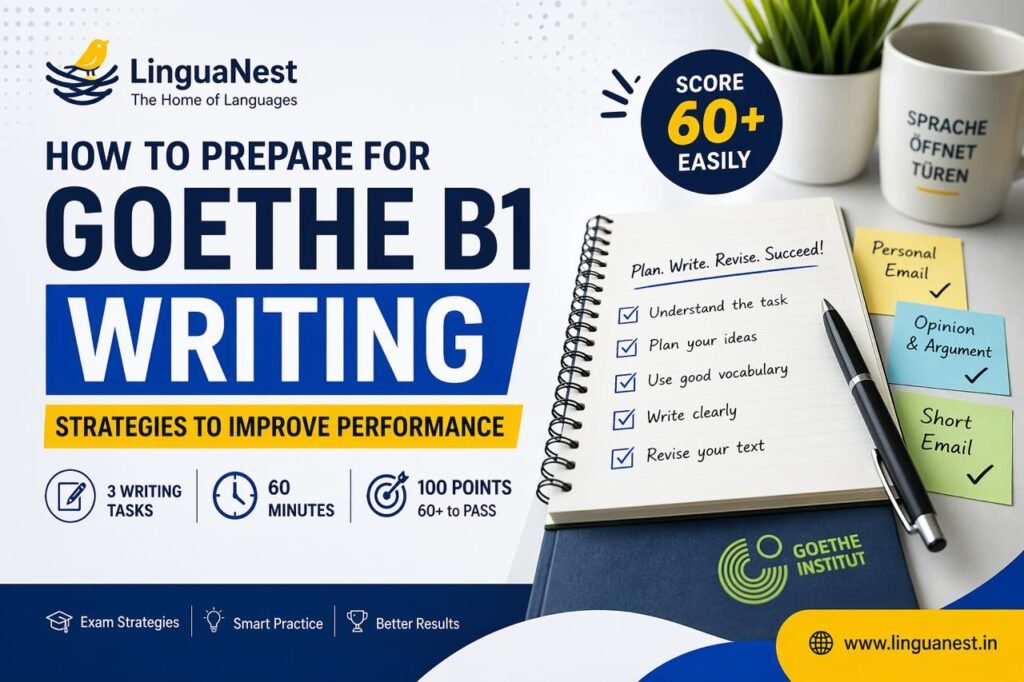
How to Prepare for Goethe B1 Writing: Smart Strategies to Improve Your Performance
The Goethe B1 writing section can feel stressful at first, but with the right strategy, you can write clearly, stay organized, and score confidently. In this guide, we break down the exam format, the three writing tasks, and the best techniques to help you perform better on test day.
Goethe B1 Writing Overview
The writing section of the Goethe B1 exam checks whether you can produce short, meaningful, and well-structured texts in German. You need to show that you can respond to a real-life communication situation, give your opinion, and write with clarity.
This part of the exam is not only about grammar. Examiners also look at structure, coherence, vocabulary range, and whether you fully answer the task.
What Examiners Expect
- Relevant text type Write the correct kind of text such as an email or short opinion piece.
- Coherent ideas Your text should have a logical flow and clear message.
- Sentence variety Use a mix of simple and slightly more complex structures.
- Good vocabulary Show useful B1-level vocabulary, not only basic repeated words.
- Accurate grammar Verb position, tense, articles, cases, and connectors matter.
Structure of the Goethe B1 Writing Section
The writing module has three tasks. Once you understand the purpose of each one, preparation becomes much easier. Instead of memorizing random answers, learn the pattern behind each task.
Task 1: Personal Email
You usually write a personal email of about 80 words. This task often asks you to describe an event, explain something, and suggest a future action.
- Use a friendly opening and closing.
- Answer all content points in order.
- Keep the tone natural and personal.
- Write clearly about a past or recent situation.
Task 2: Opinion / Discussion Text
In this task, you write around 80 words to express and defend your opinion. You may react to a statement and take part in a debate.
- State your opinion early.
- Give 2–3 clear supporting points.
- Use connectors like denn, deshalb, aber, außerdem.
- End with a short concluding sentence.
Task 3: Short Functional Email
This is a shorter email of about 40 words. You may need to apologize, inform someone, cancel something, or react briefly to a situation.
- Be direct and polite.
- Use the correct formula for the situation.
- Do not write too much.
- Make sure the action requested is clear.
Best Time Strategy for 60 Minutes
Good writing is not just about language skills. Time management can make a huge difference. If you spend too long on the first task, you may rush the final one and lose easy marks.
Read the prompt carefully, plan quickly, and write a complete personal email.
Take more time here because argumentation and structure are very important.
Keep the message short, polite, and exactly focused on the task.
Reread all texts and fix grammar, spelling, capitalization, and missing points.
Top Strategies to Improve Your Goethe B1 Writing Performance
1. Learn the text types
Even if the topic changes, the text forms stay familiar. Prepare standard structures for:
- Personal email to a friend
- Short opinion or discussion text
- Apology or action-regulation email
When you know the usual format, you save time and feel less stressed in the exam.
2. Always answer every bullet point
Many students write grammatically correct German but still lose points because they miss one of the required content points. Underline the key points before you start writing.
- What happened?
- Why do you think so?
- What do you suggest or request?
3. Use connectors to make your text flow
Coherence is a major scoring factor. Connectors help your writing sound more natural and organized.
- First ideas: zuerst, erstens, am Anfang
- Adding points: außerdem, auch, dazu
- Reason: denn, weil
- Result: deshalb, darum, deswegen
- Contrast: aber, trotzdem
4. Keep your sentences B1-level, not overcomplicated
You do not need very advanced German to score well. What matters is writing clearly and correctly. Use a mix of:
- Simple main sentences
- Subordinate clauses with weil, dass, wenn
- Useful everyday vocabulary
- Accurate verb position
What to Check in the Final 5–10 Minutes
Revision can save easy points. Before submitting, quickly review the details that examiners notice immediately.
- Did you capitalize all nouns?
- Did you include all required points from the prompt?
- Are your verbs correctly conjugated?
- Did you use the correct opening and closing formula?
- Are there spelling mistakes or missing words?
- Does the text match the required type and tone?
- Did you use commas correctly before subordinate clauses?
Common Mistakes to Avoid
- Writing too few words and not developing your idea enough
- Ignoring one bullet point from the task
- Using English-style sentence order in German
- Repeating the same vocabulary again and again
- Forgetting greetings and sign-off in emails
- Trying to sound too advanced and making avoidable grammar mistakes
- Not saving time for revision
Simple Task 1 Email Structure
Liebe/Lieber ...,

wie geht es dir? Ich möchte dir von ... erzählen.

Letzte Woche / gestern / vor ein paar Tagen ...
[Describe the event briefly.]

Besonders toll fand ich ...
[Say why.]

Hast du am Wochenende Zeit?
Wir können uns treffen / zusammen etwas machen.

Liebe Grüße
[Your Name]
Final Thoughts
The Goethe B1 writing exam is absolutely manageable when you prepare with the right method. Focus on text structure, clear communication, useful connectors, and careful revision. Do not try to impress with difficult sentences. Instead, aim for accuracy, relevance, and confidence.
The more you practice real exam-style tasks, the faster and more natural your writing will become. Build a habit of writing short emails, opinion paragraphs, and apology messages in German. Over time, this will improve both your fluency and your exam performance.
Want Better Results in Goethe B1 Writing?
At LinguaNest, we help learners prepare for German exams with focused writing practice, feedback-driven correction, and smart strategies for every task type.
Visit LinguaNest