
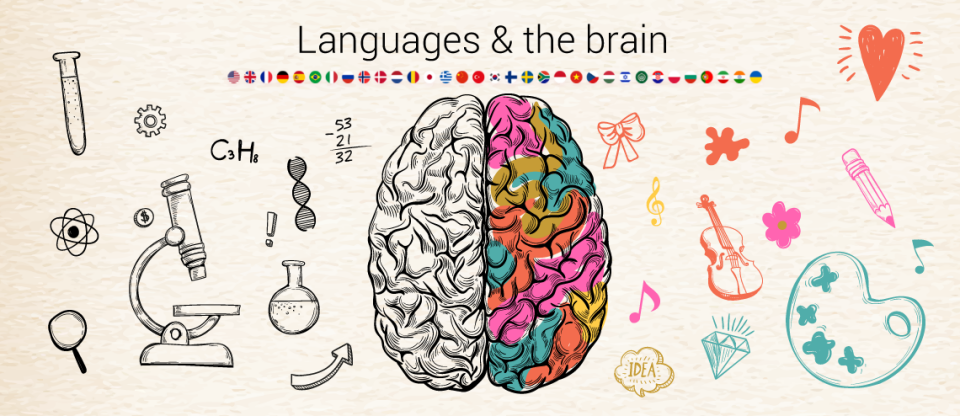
You’ve put in the work. You’ve studied grammar, stumbled through conversations, and started dreaming in another language. Here’s what all that effort is quietly doing for your brain — and your life.
If you’re at the intermediate stage of learning a language, you’re probably familiar with the plateau that strange, slightly frustrating place where you understand most things, but fluency still feels just out of reach. It can be tempting to wonder: Is all this effort actually worth it?
The answer, backed by decades of research, is a warm and resounding yes. And the benefits stretch far beyond simply being able to order coffee in another city.
“Every language you learn gives you a new window through which to see the world and a new room inside your own mind.”
Your brain is getting a serious workout
When you speak two languages, your brain is constantly managing both of them — even when you’re only using one. This ongoing mental juggling act strengthens the parts of your brain responsible for focus, problem-solving, and filtering out distractions. Researchers call this your “cognitive reserve,” and bilinguals tend to have more of it.
What does that mean in everyday life? You’re likely better at multitasking, quicker at switching between tasks, and more resilient to cognitive decline as you age. Studies have found that bilingualism can delay the onset of Alzheimer’s symptoms by several years — not a bad return on investment for your vocabulary flashcards.
5 benefits you’re already building
1. Deeper empathy
Learning another language means learning how another culture thinks. You start to notice that some emotions, concepts, and humour simply don’t translate — and that realisation makes you a more thoughtful, curious person.
2. Sharper focus
Bilinguals outperform monolinguals on tasks that require ignoring irrelevant information. Your brain has been quietly training its attention muscles every time you switch between languages.
3. Wider career doors
Bilingual professionals earn on average 5–20% more than their monolingual counterparts. In global industries, being able to work across languages is increasingly a genuine advantage, not just a nice-to-have.
4. Faster third language acquisition
Once your brain has learned how to learn a language, it becomes significantly better at doing it again. Intermediate learners often find that picking up a third language is noticeably easier than the second.
5. Richer travel experiences
Speaking even intermediate-level Spanish, French, or Japanese changes how locals treat you — and how deeply you can engage with a place. You move from tourist to guest.
The plateau is part of the process
Here’s something worth holding onto when the going feels slow: the intermediate stage is where most of the deep work happens. You’re not just memorising words anymore — you’re rewiring how you process information, building intuition, and developing a genuine feel for the rhythm of the language.
Every podcast you half-understand, every conversation you stumble through, every grammar rule that suddenly clicks — it’s all compounding. The benefits listed above don’t arrive all at once. They accumulate quietly, like interest in a savings account you forgot you opened.
You don’t have to be fluent to reap the rewards. Research shows that even partial bilingualism — the kind you’re building right now — activates many of the same cognitive benefits as full fluency.
So keep going. You’re not just learning a language — you’re expanding what it means to be you.
Ready to take your next step? Explore LinguaNest’s blogs for intermediate learners like you.
Learn French with Official Learning centre in Delhi offers high quality of French Training both offline and Online across the globe.