
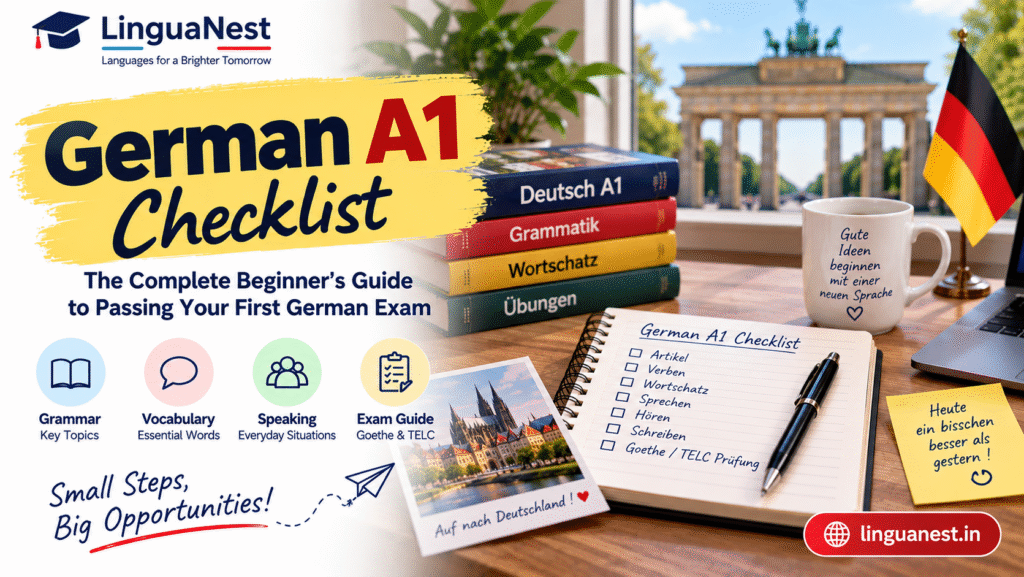
German A1 Checklist: The Complete Beginner’s Guide to Passing Your First German Exam
✍️ By Lingua Nest Editorial Team | 📅 Last updated: September 2026 | ⏱ 8 min read
Photo: Elsa Tonkinwise / Unsplash

If you are starting German from zero — whether for a spouse visa, an Ausbildung application, or simply your first step toward working in Germany — the German A1 level is where every journey begins. But “A1” can feel vague when you’re just getting started. What exactly do you need to know? How much vocabulary is enough? What does the exam actually look like?
This checklist breaks German A1 down into the grammar, vocabulary, speaking skills, and exam format you need to cover — so you walk into your course (or your exam hall) knowing exactly where you stand.
German A1 Checklist at a Glance
Here is every topic on this German A1 checklist in one place — save this table and tick each row off as you go.
| Skill Area | Topic to Master | Priority |
|---|---|---|
| Grammar | German Articles — der, die, das & Noun Gender | ● Must-Know |
| Grammar | Nominative & Accusative Case Basics | ● Must-Know |
| Grammar | Present Tense Verb Conjugation (sein, haben, machen) | ● Must-Know |
| Grammar | W-Questions & Negation (nicht / kein) | ● Good-to-Know |
| Grammar | Modal Verbs — können, möchten, müssen | ● Good-to-Know |
| Vocabulary | Greetings, Numbers 1–100 & Telling Time | ● Must-Know |
| Vocabulary | Family, Food & Everyday Professions | ● Good-to-Know |
| Speaking | 60-Second Self-Introduction Script | ● Must-Know |
| Listening | Everyday Conversations & Public Announcements | ● Good-to-Know |
| Exam Format | Goethe / TELC Reading, Writing, Listening & Speaking Sections | ● Must-Know |
What Does German A1 Level Actually Mean?
A1 is the first and most basic level on the six-level scale used across Europe to measure language ability, known as the CEFR (Common European Framework of Reference for Languages). At A1, you are officially a “basic user” — someone who can understand and use simple, everyday expressions, introduce themselves, and hold a very basic conversation if the other person speaks slowly and clearly.
You can see exactly what’s expected at each CEFR level, including A1, in the Council of Europe’s official self-assessment grid.
According to the Goethe-Institut, reaching a solid A1 level typically takes between 80 and 200 teaching units of 45 minutes each, depending on your prior exposure to the language and how intensively you study.
Who Actually Needs a German A1 Certificate?
A1 isn’t just a “beginner milestone” — for many learners, it’s a document requirement. You’ll likely need a recognised A1 certificate if you are:
- Applying for a family reunification (spouse) visa to join a partner already living in Germany — most German missions require proof of basic German before the visa is issued.
- Applying as an au pair in a German-speaking household.
- Starting an Ausbildung (vocational training) application, where A1 is often the minimum starting point before progressing to B1.
- Building points toward the Opportunity Card (Chancenkarte), where any documented German ability adds to your score.
- A complete beginner simply starting a structured path toward B1 or B2 for study, nursing, or skilled-worker visas.
If your long-term goal is working in Germany, it’s worth reading our guide on career opportunities for Indians in Germany to see exactly where A1 fits into the bigger picture.
The Complete German A1 Checklist
Photo: Markus Spiske / Unsplash

1. Grammar Checklist
By the end of A1, you should be comfortable with:
- Definite and indefinite articles — der, die, das / ein, eine, ein — and basic noun gender.
- Nominative and accusative case — enough to identify a sentence’s subject and direct object.
- Personal pronouns — ich, du, er/sie/es, wir, ihr, sie/Sie.
- Present tense conjugation of regular verbs (machen, lernen, wohnen) and key irregular verbs (sein, haben, sprechen).
- W-questions — wer, was, wo, wann, warum, wie — and how to form yes/no questions.
- Negation using nicht and kein.
- Basic modal verbs — können, möchten, müssen — in simple sentences.
- Possessive articles — mein, dein, sein, ihr.
- Verb-second (V2) word order in simple main clauses.
For a deeper walkthrough of each of these rules with examples, see our complete German grammar guide for beginners.
2. Vocabulary Checklist
A1 vocabulary is built around everyday survival topics. Make sure you can comfortably use words and phrases related to:
- Greetings and introductions (Guten Tag, Wie heißt du?, Ich komme aus …)
- Numbers 1–100, and basic time expressions
- Days of the week, months, and telling the time
- Family members (Familie, Mutter, Bruder, Kinder)
- Food, drinks, and ordering in a restaurant or café
- Professions and workplaces (Beruf, Arbeit, Büro)
- Common adjectives (groß, klein, gut, schlecht, neu, alt)
- Shopping and prices (Wie viel kostet das?)
- Directions and basic travel phrases
3. Speaking & Listening Checklist
The speaking section is where most self-taught learners lose marks — not because they don’t know grammar, but because they haven’t practised out loud. Before your exam, you should be able to:
- Introduce yourself confidently in under a minute (name, origin, profession, family, hobbies).
- Ask and answer personal questions with a partner (Wo wohnst du? Was machst du beruflich?).
- Politely ask someone to do something (Können Sie bitte …?).
- Understand short, slow, clearly spoken announcements, phone messages, and everyday conversations.
4. Exam Format Checklist
Most Indian learners take either the Goethe-Zertifikat A1: Start Deutsch 1 or the TELC A1 exam. Both test the same four skills, though the exact timing varies slightly by provider:
| Section | What It Tests | Typical Duration |
|---|---|---|
| Reading | Short notes, signs, simple advertisements | ~25 minutes |
| Listening | Short conversations, announcements, phone messages | ~20 minutes |
| Writing | Filling forms, writing a short personal text | ~20 minutes |
| Speaking | Self-introduction and simple Q&A, usually in pairs | ~15 minutes |
You can find the official exam structure and registration details directly on the Goethe-Institut’s Start Deutsch 1 page.
Goethe A1 vs TELC A1: Which Certificate Should You Choose?
Photo: Nathan Cima / Unsplash

| Factor | Goethe-Zertifikat A1 | TELC A1 |
|---|---|---|
| Best suited for | General visa purposes, au pair applications, broad recognition | Popular for nursing pathways and family visa applications |
| Issued by | Goethe-Institut | telc gGmbH |
| Global recognition | Very widely recognised | Widely recognised, especially in professional/healthcare pathways |
If you’re also planning ahead to B1 or B2 for work or study visas, our detailed TestDaF vs Goethe exam comparison is a useful next read.
Common Mistakes Beginners Make at A1 Level
- Skipping speaking practice — grammar drills alone won’t prepare you for the oral section.
- Memorising vocabulary lists without context — words stick better inside full sentences.
- Ignoring gender and case from day one — bad habits at A1 compound quickly at A2 and B1.
- Studying only on weekends — even 20 minutes of daily practice beats one long weekly session.
- Avoiding mistakes instead of making them — confidence at A1 matters more than perfection.
Free Resources to Practice German A1
- Goethe-Institut — official Start Deutsch 1 exam information
- Council of Europe — CEFR self-assessment grid
Frequently Asked Questions
Is German A1 hard for absolute beginners?
No — A1 is designed specifically for people with zero prior knowledge. It focuses on simple, everyday communication rather than complex grammar, making it the most approachable level in the CEFR scale.
How many hours does it take to reach German A1?
Most learners need roughly 80–200 hours of structured teaching, depending on how intensively they study and whether they have prior exposure to another Germanic or European language.
Is Goethe A1 or TELC A1 accepted for a spouse visa?
Both are generally accepted by German missions, but requirements can vary by consulate and applicant category, so it’s worth confirming directly with your local German embassy or consulate before booking an exam.
Can I prepare for German A1 online from India?
Yes. Structured live online classes with a certified trainer, regular mock tests, and dedicated speaking practice can take you from zero to exam-ready A1 in a few months.
Ready to start your German A1 journey? LinguaNest’s structured German language course takes you from A1 through to advanced levels, with dedicated Goethe and TELC exam preparation, mock tests, and small-batch speaking practice — both online and offline.