
German Verbs with Prefixes Explained: Separable vs Inseparable Verbs (2026 Guide)
German prefix verbs are one of the most important grammar concepts every learner must master. Understanding how separable and inseparable verbs work will dramatically improve your reading, listening, speaking, and writing skills.

Table of Contents
Quick Answer
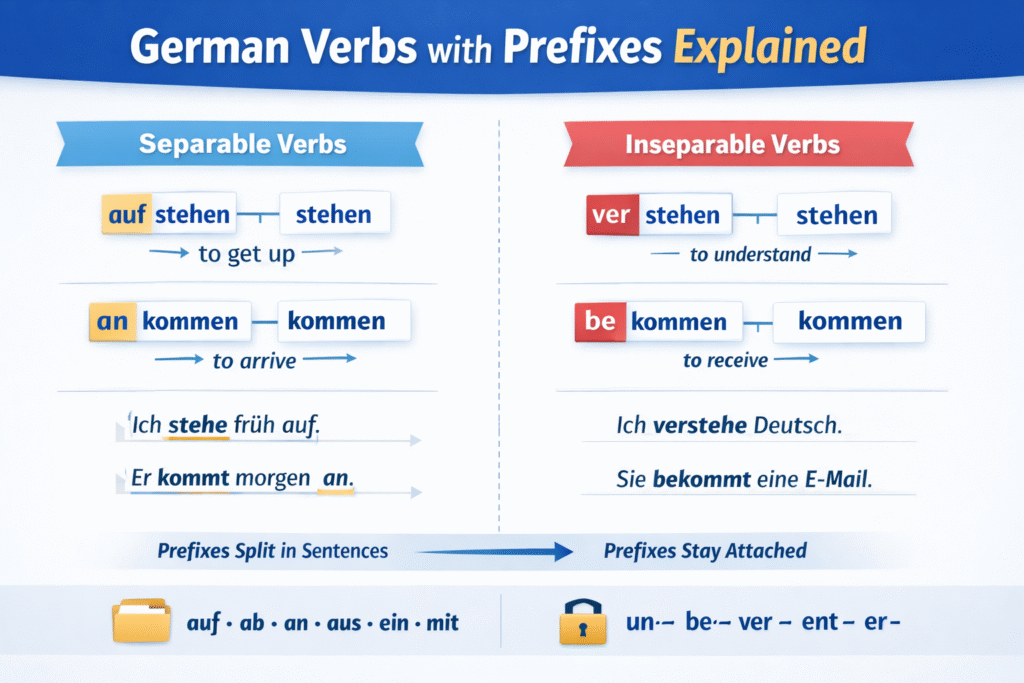
Separable verbs split into two parts in many sentence structures, while inseparable verbs always remain together. Understanding this difference is essential for German grammar and sentence construction.
What Are German Prefix Verbs?
German creates many new verbs by adding prefixes to existing verbs. These prefixes change the meaning and sometimes affect sentence structure.
| Base Verb | Meaning | Prefix Verb | New Meaning |
|---|---|---|---|
| stehen | to stand | aufstehen | to get up |
| kommen | to come | ankommen | to arrive |
| hören | to hear | zuhören | to listen |

What Are Separable Verbs?
Separable verbs divide into two parts when used in many German sentences. The prefix moves to the end of the sentence.
Example: aufstehen
Infinitive: Ich möchte früh aufstehen.
Present: Ich stehe um 6 Uhr auf.
Common Separable Prefixes
- ab-
- an-
- auf-
- aus-
- ein-
- mit-
- nach-
- vor-
- zu-
Examples
| Verb | Meaning | Sentence |
|---|---|---|
| abholen | pick up | Ich hole meinen Freund ab. |
| ankommen | arrive | Er kommt morgen an. |
| einkaufen | shop | Wir kaufen heute ein. |
| mitkommen | come along | Kommst du mit? |
What Are Inseparable Verbs?
Inseparable verbs never split. The prefix always remains attached to the verb.
Example
Ich verstehe Deutsch.
The prefix “ver” remains attached to the verb.
Common Inseparable Prefixes
- be-
- emp-
- ent-
- er-
- ge-
- miss-
- ver-
- zer-
| Verb | Meaning | Example |
|---|---|---|
| bekommen | receive | Ich bekomme eine Nachricht. |
| empfehlen | recommend | Kannst du ein Buch empfehlen? |
| verstehen | understand | Ich verstehe die Frage. |
| zerstören | destroy | Der Sturm zerstört das Dach. |

Separable vs Inseparable Verbs
| Feature | Separable | Inseparable |
|---|---|---|
| Prefix Moves? | Yes | No |
| Sentence Split? | Yes | No |
| Common Prefixes | auf, an, ab, aus | ver, be, ent, er |
| Example | aufstehen | verstehen |
Sentence Structure Rules
Present Tense
Ich stehe früh auf.
Question Form
Stehst du früh auf?
Perfect Tense
Ich habe früh aufgestanden.
Inseparable Verb Example
Ich habe die Lektion verstanden.
Common Mistakes Learners Make
Incorrect Prefix Placement
❌ Ich aufstehe um sechs Uhr.✅ Ich stehe um sechs Uhr auf.
Separating Inseparable Verbs
❌ Ich stehe Deutsch ver.✅ Ich verstehe Deutsch.
Practice Exercises
- Ich _____ um sieben Uhr _____. (aufstehen)
- Wir _____ Deutsch. (verstehen)
- Er _____ seinen Freund _____. (abholen)
Answers
- Ich stehe um sieben Uhr auf.
- Wir verstehen Deutsch.
- Er holt seinen Freund ab.
Related German Grammar Guides
- German Word Order Guide
- German Cases for Beginners
- German Modal Verbs Explained
- German Perfect Tense Guide
- German A1 Learning Roadmap
External Resources
Frequently Asked Questions
What is a separable verb in German?
A separable verb contains a prefix that moves to the end of the sentence.
What is an inseparable verb?
An inseparable verb always keeps its prefix attached.
How many German prefix verbs exist?
There are hundreds, but mastering the most common prefixes covers a large portion of everyday German.
Continue Learning German with LinguaNest
Ready to take your German skills further? Explore our guides on German cases, word order, modal verbs, and A1 grammar essentials.
Visit LinguaNestFinal Thoughts
German separable and inseparable verbs may seem challenging at first, but once you understand the patterns, they become much easier to use. Learn the common prefixes, practice with real sentences, and review regularly. Soon you’ll recognize these verb structures naturally while reading and speaking German.