
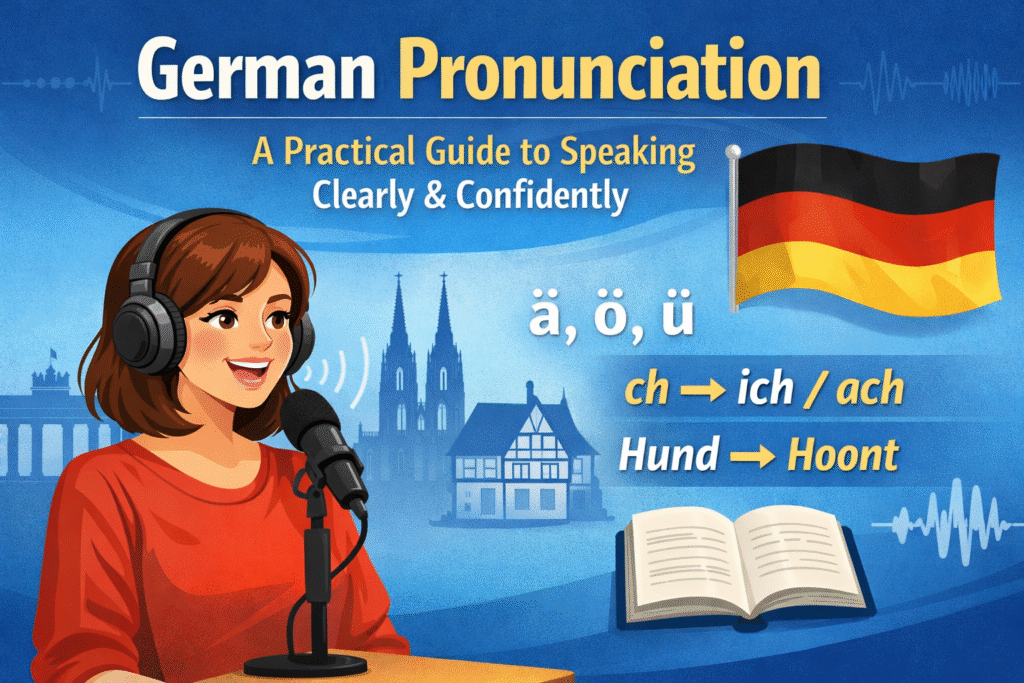
When learning German, many students focus heavily on vocabulary and grammar. While these are important, pronunciation is often overlooked—and that’s where real communication breaks down.
You might understand written German perfectly, yet struggle to speak or follow native conversations. This happens because pronunciation directly impacts both speaking clarity and listening comprehension.
German is phonetic, but not always intuitive. Small sound differences can completely change meanings. For example:
- schon (already) vs schön (beautiful)
- bitte (please) vs biete (offer)
Mastering pronunciation helps you avoid confusion and sound more natural in conversations.
Core Elements of German Pronunciation
1. Vowel Length
One of the most important aspects of German pronunciation is vowel length.
- Short vowels: bitte, mit, kann
- Long vowels: bieten, mir, kannst
Mispronouncing vowel length can make your speech unclear or even change the meaning entirely. Practice holding long vowels slightly longer and keeping short vowels crisp.
2. Umlauts (ä, ö, ü)
Umlauts are unique sounds in German that don’t exist directly in English:
- ä – similar to “e” in bed
- ö – say “e” while rounding your lips
- ü – say “ee” while rounding your lips
These sounds require physical adjustment of your mouth. Practicing in front of a mirror can help you get the lip positioning right.
3. The “ch” Sound
German has two distinct “ch” sounds:
- Soft “ch” (ich sound): ich, nicht
- Hard “ch” (Bach sound): Bach, doch
The soft version is produced near the front of the mouth, while the hard version comes from the back of the throat. This is one of the most challenging sounds for learners but crucial for sounding natural.
4. The German “r”
The German “r” is usually pronounced at the back of the throat, unlike the English “r.”
- rot (red)
- besser (better)
In some cases, especially at the end of words, the “r” becomes softer or almost silent. Listening to native speakers helps you understand these subtle variations.
5. Final Consonant Devoicing
In German, voiced consonants at the end of words often become voiceless:
- Tag → “Tahk”
- Hund → “Hoont”
This gives German its characteristic sharp and clear sound. Ignoring this rule can make your pronunciation sound unnatural.
Common Challenges Learners Face
Many learners encounter similar issues:
- Hesitation while speaking
- Difficulty understanding native speakers
- Lack of confidence in conversations
These problems usually stem from insufficient pronunciation practice rather than lack of knowledge.
Effective Strategies to Improve Pronunciation
Active Listening
Listen to native German content like podcasts, videos, or news. Focus on how words are pronounced, not just what they mean.
Shadowing Technique
Repeat sentences immediately after hearing them. This improves rhythm, fluency, and accent.
Self-Recording
Record yourself speaking and compare it with native audio. This helps identify mistakes and track progress.
Target Difficult Sounds
Spend extra time on challenging areas like umlauts and “ch” sounds. Focused practice leads to faster improvement.
Consistency is Key
Even 10–15 minutes of daily pronunciation practice can significantly improve your speaking skills over time.
Conclusion
Clear pronunciation is the foundation of effective communication in German. It not only improves your speaking but also enhances your ability to understand native speakers.
Instead of focusing only on learning new words, start asking: Can I pronounce them correctly?
At LinguaNest, we believe in combining theory with practical training. Our language courses in German, French, Japanese, Russian, and English are designed to help you speak with clarity, confidence, and precision.
7 Speaking
Enhance your fluency with 7 Speaking, an AI-powered platform designed to improve your speaking skills through real-time practice and feedback. Perfect for learners aiming to build confidence and accuracy in conversations.
PrepMyFuture
Prepare for international exams with PrepMyFuture, offering structured practice, mock tests, and performance analytics. Ideal for achieving top scores in exams like IELTS, TOEFL, and more.
Start focusing on pronunciation today—and take your German fluency to the next level.