
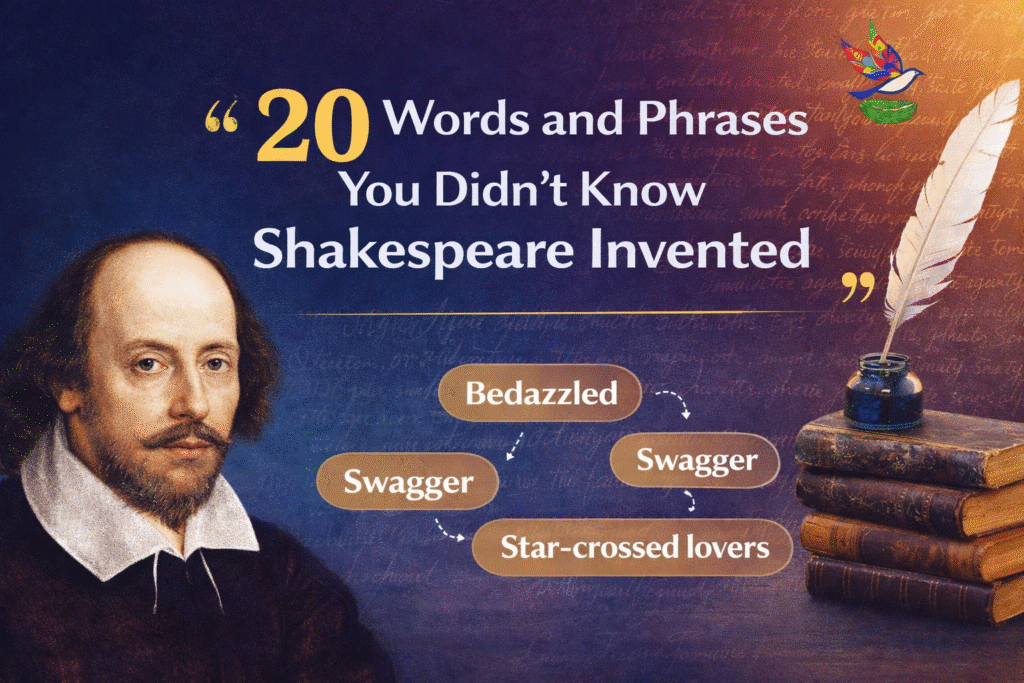
William Shakespeare is widely celebrated as one of the greatest writers in history—but his influence goes far beyond literature. What many English learners don’t realize is that Shakespeare invented words and phrases we still use in everyday English.
At Lingua Nest, where we teach global languages like English, French, German, Japanese, and Russian, understanding the roots of language plays a key role in mastering it. Shakespeare alone contributed over 1,700 words to English, shaping how the language is spoken even today.
Let’s explore 20 English words and phrases invented by Shakespeare that prove language learning can be both historical and fascinating.
Why Shakespeare Matters in English Language Learning
Shakespeare lived over 450 years ago, yet his language feels surprisingly modern. He experimented with:
- Turning nouns into verbs
- Creating expressive adjectives
- Coining entirely new words
This creativity helped English evolve into a flexible, global language, making Shakespeare an essential figure in the history of English language learning.
20 Shakespeare-Invented Words and Phrases Still Used Today
1) Addiction
First used in Othello, referring to obsessive devotion.
2) All the world’s a stage
From As You Like It, comparing life to a performance.
3) Bedazzled
Used in The Taming of the Shrew to describe overwhelming brightness.
4) Brave new world
From The Tempest, expressing wonder at new possibilities.
5) Critic
Introduced in Love’s Labour’s Lost in its modern sense.
6) Eventful
Coined in As You Like It, meaning full of happenings.
7) Eyeball
First appeared in The Tempest.
8) Generous
Used in Julius Caesar to mean noble and kind.
9) Good riddance
From Troilus and Cressida, expressing relief.
10) In a pickle
From The Tempest, meaning trouble or confusion.
11) It’s Greek to me
From Julius Caesar, meaning hard to understand.
12) Lonely
First used in Coriolanus.
13) Majestic
From Henry VIII, describing grandeur.
14) Manager
Introduced in A Midsummer Night’s Dream.
15) Radiance
Used in The Two Gentlemen of Verona.
16) Star-crossed lovers
From Romeo and Juliet, describing doomed love.
17) Swagger
Used to describe arrogant movement.
18) Undress
Popularized in The Taming of the Shrew.
19) Wild-goose chase
From Romeo and Juliet, meaning a futile pursuit.
20) To thine own self be true
From Hamlet, emphasizing self-honesty
How Literature Improves Language Learning
Learning where words come from improves:
- Vocabulary retention
- Cultural understanding
- Speaking confidence
At Lingua Nest, we believe strong language skills come from context, culture, and communication, not memorization alone.
Final Thoughts
When you use words like lonely, swagger, or good riddance, you’re unknowingly echoing Shakespeare. His contribution proves that language is alive—and learning it becomes easier when you understand its roots.
Whether you’re mastering English or another foreign language, linguistic awareness makes you a stronger global communicator.