
Master personal pronomen in German! Learn pronouns, cases, and usage with clear examples for effective German communication.
Understanding Personal Pronomen in German
Learning personal pronouns in German is an essential part of becoming proficient in the German language. Personal pronouns are the basic constituents that help you build sentences. Whether you are a novice learner or wish to improve your grammatical skills, it is important to understand how personal pronouns function in the German language.
What Are Personal Pronouns in German?
Personal pronouns replace nouns and refer to people or things. In German, these pronouns change their form depending on the grammatical case (nominative, accusative, dative, or genitive) and the person being referenced. This might seem challenging at first, but with practice, using personal pronomen in German becomes second nature.
The Four Cases of Personal Pronouns
Nominative Case (Subject) The nominative case identifies who is performing the action:
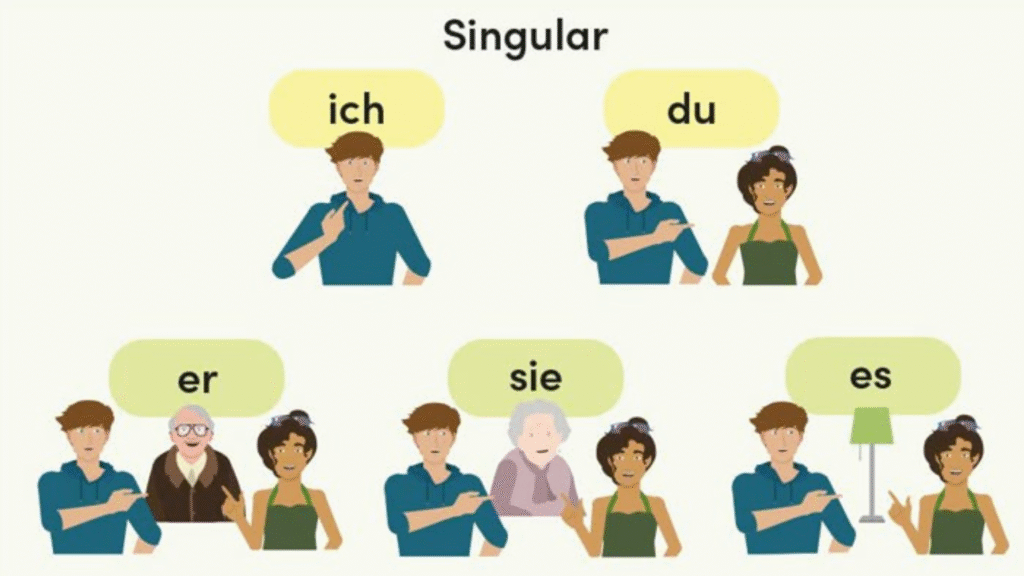
- ich (I), du (you—informal), er/sie/es (he/she/it)
- wir (we), ihr (you – plural informal), sie/Sie (they/you – formal)
Accusative Case (Direct Object) Used when the pronoun receives the action directly:
- mich (me), dich (you), ihn/sie/es (him/her/it)
- uns (us), euch (you—plural), sie/Sie (them/you—formal)
Dative Case (indirect object) indicates to whom or for whom something is done:
- mir (to me), dir (to you), ihm/ihr/ihm (to him/her/it)
- uns (to us), euch (to you), ihnen/Ihnen (to them/to you—formal)
Common Mistakes When Using Personal Pronomen in German
Many students find it difficult to select the appropriate case. A common mistake is to use the nominative case in contexts requiring the accusative and dative cases. The error occurs when one says “Ich sehe du” instead of the correct “Ich sehe dich.” The final common pitfall is in the capitalization of the word “Sie,” which is always capitalized in formal usage, while the word “sie,” referring to they/she, is not.
Practical Tips for Mastering German Personal Pronouns
Practice with Real Sentences Apply personal pronomen in German through daily conversation practice. Create simple sentences and gradually increase complexity as you become comfortable.
Learn Through Context Understanding which case to use becomes easier when you learn pronouns in complete sentences rather than memorizing isolated lists.
Pay Attention to Verbs: Certain verbs require specific cases. For instance, “helfen” (to help) always takes the dative case: “Ich helfe dir” (I help you).
Why Choose Lingua Nest for Learning German?
At Lingua Nest, we realize that learning personal pronouns in German needs to be done in a guided fashion to become proficient in them. This is exactly what we do in our extensive German lessons—teach you to master personal pronouns in German in a thorough and efficient manner. Whether you want to study German for purposes of travel, business, or learning, we teach you to get a solid grammar base.
Apart from German, at Lingua Nest, you can find professional language classes in French, Japanese, Russian, and English. Thus, it is the ultimate place to learn languages.
Conclusion
German personal pronomen mastery is the key to confident communication and language understanding. Though the case system in the German language may appear to be complicated, it can be dealt with when practiced and learned in the right manner. Begin your German learning experience today with LinguaNest.in and change your language proficiency forever.